
There is no single national child support formula. Every state picks one of three calculation models, and which one applies depends entirely on where your case is filed. The difference is real, not academic. Two parents with the same incomes, the same jobs, and the same number of kids can end up with meaningfully different numbers depending on which side of a state line they live on. This guide walks through all three formulas, shows the math with real numbers, and covers the 2026 changes that actually matter to your case.
Disclaimer: This guide is for informational purposes only and is not legal advice. Child support guidelines vary by state and change regularly. Courts retain discretion to deviate from guideline amounts. Consult a licensed family law attorney in your state for advice about your specific case.
Child support is calculated using one of three state formulas. Income Shares, used by the majority of states, combines both parents' incomes, reads a total obligation off a state schedule, and splits it based on each parent's share. Percentage of Income, used by a handful of states including Texas and Wisconsin, takes a fixed percentage of the paying parent's income alone: 20 percent for one child in Texas, rising to 40 percent for five. The Melson Formula, used only in Delaware, Hawaii, and Montana, protects a basic living allowance for each parent before anything else is calculated. Use our free Child Support Calculator to see what your state's formula produces for your situation.
Three Formulas, Fifty States
Every state in the country runs child support through a published guideline formula. Judges are presumed to follow it. Deviating from the guideline requires written findings explaining why the standard result would be unjust or inappropriate. That is a high bar, and most orders land within the guideline range.
The formulas group into three families, and they do not produce the same result. Knowing which one your state uses is the first step to understanding your number.
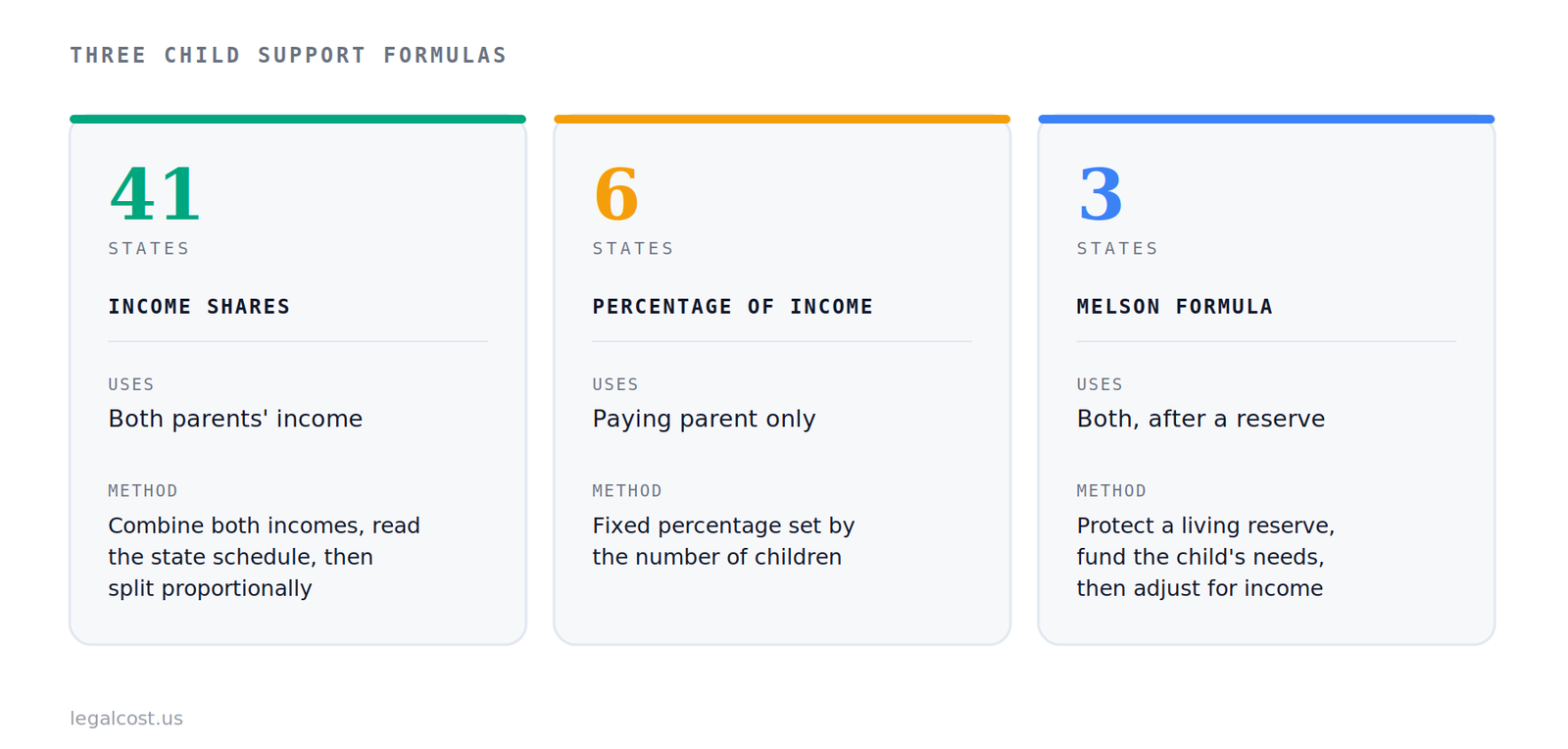
Combines both parents' incomes, finds the total obligation on a state schedule, then divides it proportionally. The dominant model nationally, used in over 40 states including California, Florida, New York, and Illinois.
Applies a fixed percentage to the paying parent's income only. The custodial parent's income plays no role in the base calculation. Used in Texas, Wisconsin, Mississippi, Nevada, North Dakota, and Alaska.
Reserves a basic living allowance for each parent first, funds the child's core needs, then adds a quality-of-life adjustment. Used only in Delaware, Hawaii, and Montana.
The District of Columbia uses a hybrid approach that borrows elements from more than one model. Puerto Rico and the US territories run their own variants. Exact state counts vary slightly depending on how sources classify borderline cases, because a few states blend features from different models.
The Income Shares Model: How Most States Do It
Income Shares rests on a straightforward idea. A child should receive roughly the same share of parental income they would have received if the parents had stayed together. So the calculation begins by asking what an intact family at that combined income level would typically spend on raising a child.
That number is not guesswork. State schedules are built on consumer expenditure research, most commonly the Betson-Rothbarth methodology. That research compares spending patterns in households with and without children at various income levels, then estimates the marginal cost of the child. Each state adopts its own schedule based on this data and updates it periodically, though "periodically" can mean anything from every four years to once a decade.
The Four Steps
The basic sequence is the same across Income Shares states, even though the schedules, income definitions, and adjustment rules differ.
A Worked Example
Take two parents with one child. Parent A earns $5,000 per month gross. Parent B earns $3,000. Parent B has primary custody.
The $930 schedule figure is illustrative. Each state publishes its own table, and the amounts differ meaningfully between them. Colorado's table will give you a different number than Georgia's for the same combined income. What stays constant is the structure: total obligation first, then a proportional split.
Now notice what happens if Parent B's income rises. Say both parents earn $5,000. Parent A's share drops from 62.5 percent to 50 percent, and the monthly obligation falls, even though Parent A earns exactly the same amount. That is the defining feature of Income Shares, and it is the single most common source of confusion for parents who compare their order to a friend's in a different state or with a different income mix.
The Percentage of Income Model
Percentage of Income is the simplest of the three models. It looks only at the paying parent's income and ignores the custodial parent's income entirely in the base calculation. A statutory percentage is applied, scaled by the number of children. That is the whole calculation.
The states most commonly classified under this model include Texas, Wisconsin, Mississippi, Nevada, North Dakota, and Alaska. Illinois used this model until July 1, 2017, when it switched to Income Shares, so older articles that list Illinois in this group are out of date.
Texas: The Clearest Example
Texas is the most transparent example of this model because the percentages are written directly into statute. Under Family Code section 154.125, a fixed percentage is applied to the paying parent's monthly net resources. Not gross income. Net resources.
| Children | Percentage of net resources | Maximum at the $11,700 cap |
|---|---|---|
| 1 | 20% | $2,340 |
| 2 | 25% | $2,925 |
| 3 | 30% | $3,510 |
| 4 | 35% | $4,095 |
| 5 or more | 40% | $4,680 |
What Counts as Net Resources in Texas
This is where people trip up. Texas uses "net resources," and the list of what you can subtract from gross income is much shorter than most parents assume. Under Family Code section 154.062, you start with gross income and subtract only four items: federal income tax calculated at the single-person rate (regardless of your actual filing status), Social Security and Medicare taxes (FICA), union dues, and the cost of health and dental insurance for the child.
That is it. Voluntary 401(k) contributions do not reduce your net resources. Your car payment does not count. Your mortgage, credit card bills, and student loans are irrelevant. A lot of parents walk into their attorney's office expecting that their actual take-home pay is what the court uses. It is not. The net resources figure is almost always higher than what shows up in your bank account.
Texas also sets a floor. An obligor who reports zero income is presumed to earn the federal minimum wage for a 40 hour week, and courts routinely impute income to parents who appear to be voluntarily unemployed or working below their earning capacity.
Our calculator applies your state's actual guideline model, whether that is Income Shares, Percentage of Income, or Melson.
Open the Child Support CalculatorThe Melson Formula: Delaware, Hawaii, and Montana
The Melson Formula is the most complex model and the least common. It was developed in the 1970s by Judge Elwood Melson of the Delaware Family Court, and it adds a policy layer that the other two models leave out: it explicitly protects each parent's ability to cover their own basic living costs before any support is calculated.
If you have ever wondered why some parents in Delaware seem to get lower orders than parents with similar incomes in neighboring states, this is why. The self-support reserve means that a parent earning near the poverty line keeps more of their income under Melson than they would under Income Shares.
The calculation runs in three stages.
The practical effect is distinctive. For a parent earning near the self-support reserve, Melson tends to produce a lower obligation than Income Shares would, because the reserve is protected first. For a higher earner, the standard of living adjustment in Stage 3 can push the result above what Income Shares would produce. It is the model most explicitly designed to scale with income at both ends of the spectrum.
Compared to Income Shares, Melson adds one significant layer of protection for low-income parents and one significant layer of upward adjustment for high-income parents. Income Shares does neither as directly. That is why three small states have kept the model despite the fact that it requires more calculation and more judicial discretion at each stage.
Adjustments That Change the Number
The base calculation is just the starting point. Several adjustments apply in most states regardless of which model is used, and they can move the final number significantly in either direction.
Parenting Time
This is the adjustment parents ask about most, and misunderstand most often. Once the paying parent exceeds a certain number of overnights per year, the obligation goes down. The reduction scales as overnights increase. The threshold varies by state and typically falls between 92 and 146 nights per year. Some states, like Colorado, have recently eliminated fixed overnight thresholds entirely in favor of sliding-scale adjustments.
The reasoning is straightforward. A parent with substantial parenting time is already covering housing, food, and daily costs out of pocket during their time. The adjustment prevents double-charging for the same expenses.
What it does not do, in most cases, is eliminate support entirely at a 50/50 split. If one parent earns considerably more than the other, the guideline still transfers money from the higher earner to the lower earner, because the goal is to keep the child's day-to-day standard of living roughly comparable in both households. Equal time with unequal incomes still produces a payment in most states.
Health Insurance and Childcare
The child's health insurance premium and work-related childcare costs are typically treated as add-ons. They sit on top of the base obligation and are divided between the parents in proportion to their respective incomes. Some states fold these costs into the base schedule instead of adding them on top. Extraordinary medical expenses, meaning uninsured costs above a stated threshold, are usually shared the same way.
Other Children
Most states allow a deduction or credit for children from other relationships that the paying parent is legally obligated to support. The mechanics vary. Some states deduct the existing order from income before running the new calculation. Others apply a multiple-family adjustment formula built into the guideline itself. The practical effect is that a parent supporting children from a prior relationship will generally have a lower obligation in the current case than they would otherwise.
Income Caps and Floors
Nearly every state caps the income to which guideline percentages apply. Above the cap, the court has discretion and typically needs evidence of the child's actual needs to justify a higher amount. Most states also set a minimum obligation so that a support order exists even when the paying parent reports little or no income. Texas illustrates both: the cap is $11,700 in monthly net resources, and the floor is a presumed full-time minimum wage income.
Sources: National Conference of State Legislatures guideline surveys, state child support agency publications, Texas Family Code sections 154.062 and 154.125, U.S. Census Bureau child support data. Updated September 2026. Guidelines change; verify with your state agency before relying on these figures.
What Counts as Income
Courts define income broadly, and the definition is almost always wider than a parent's mental model of "what I earn." Knowing what gets counted, and what does not, can make a real difference in your expectations going into a hearing.
Generally included: wages, salary, overtime, commissions, bonuses, tips, self-employment income, rental income, dividends, interest, pensions, annuities, unemployment benefits, and workers' compensation.
Generally excluded: means-tested public assistance such as TANF, SSI, and SNAP, plus foster care payments. The reasoning is that benefits designed to meet a household's basic subsistence needs should not be redirected to another household.
Self-Employment: Where Most Disputes Happen
If you or your co-parent is self-employed, expect this to be the most contested part of the calculation. Courts do not simply accept the bottom line on a tax return. They look at gross business revenue, subtract legitimate operating expenses, and then scrutinize what is left.
The gap between "tax income" and "child support income" can be large. A business owner who takes a modest salary but runs personal expenses through the business, a vehicle used partly for personal driving, a phone plan, meals, travel with a personal component, may find that a family court judge adds much of that back as income. The IRS and the family court have different standards for what counts as a "business expense."
Courts also tend to look at multiple years of returns rather than a single year. If income fluctuates, expect the judge to average two to three years of returns. A one-year dip will not necessarily produce a lower calculation, and a one-year spike may not produce a higher one. The court wants a realistic picture of earning capacity over time.
Imputed income: If a court finds a parent is voluntarily unemployed or working below their capacity, most states will calculate support on what that parent could reasonably earn rather than what they actually report. Quitting a job or taking a pay cut shortly before a support hearing rarely produces the intended result. Judges see this pattern regularly and are not inclined to reward it.
Changing an Existing Order
A child support order is not permanent. Either parent can petition to modify it. But the legal standard is a substantial change in circumstances, and informal agreements between parents do not change the legal obligation. The original order remains enforceable until a court issues a new one.
What typically qualifies as a substantial change: a significant income shift for either parent, commonly defined as 10 to 20 percent or a specific dollar threshold depending on the state; a change in the custody arrangement; a child aging out or becoming emancipated; or a major shift in medical costs or insurance coverage. Many states also allow a routine review every three years without requiring proof that anything changed.
Modification takes effect from the date you file the petition. Not from the date your circumstances changed. This is the single most expensive mistake in child support cases, and it is entirely avoidable. A parent who loses their job in January and does not file until June owes the full amount for those five months. There is no retroactive adjustment for the delay.
The Texas cap increase illustrates the same principle from the other side. When the cap went from $9,200 to $11,700 in September 2025, existing orders calculated under the old figure did not automatically increase. A custodial parent who wanted the higher guideline amount had to file a modification petition and get a new order from the court.
Parents who agree can set out support, custody and visitation terms in a separation agreement for the court to approve. If the numbers are disputed, get advice from a family law attorney.
Prepare your Separation Agreement on LawDepotAffiliate link: LegalCost.us earns a commission from LawDepot at no extra cost to you.
How Long Support Lasts
In most states, child support runs until the child turns 18 or graduates from high school, whichever comes later, with an outer limit around age 19 in many jurisdictions. Several states extend support further under certain conditions. A few allow courts to order contribution toward college expenses, though this is the exception rather than the rule and is often a matter of agreement between the parents rather than a guideline requirement.
Support for a child with a significant disability can continue indefinitely in some states. The legal standard is typically that the child is unable to support themselves and the disability existed before the child reached the age of majority.
Support generally terminates early if the child is legally emancipated, gets married, or enters active military service. It does not automatically end on the death of the paying parent in every state. Some jurisdictions allow claims against the estate, particularly where a support order was already in place and the child is still a minor.
Common Mistakes
These patterns come up repeatedly in child support cases. Each one costs real money.
Assuming take-home pay is the starting point. Most states use gross income. Texas uses net resources with only four narrow deductions. Your actual bank deposit after 401(k) contributions, health insurance for yourself, car payments, and everything else is rarely the figure the court plugs into the formula.
Treating a verbal agreement as binding. Parents who agree between themselves to reduce payments are not modifying the order. They are creating arrears. The original order stands, the full amount accrues every month, and the parent who stopped paying in full can face enforcement action years later for the accumulated balance. Only a court order changes the legal obligation.
Waiting too long to file after an income drop. Modification runs from the date you file the petition, not from the date your income changed. Every month you wait is a month at the old rate with no possibility of going back and adjusting it downward.
Expecting 50/50 custody to zero out support. Equal parenting time reduces the payment substantially. It eliminates it only when both parents earn roughly the same amount. If there is a meaningful income gap, the higher earner pays something even at a true 50/50 split.
Comparing your order to someone in another state. Different model, different schedule, different income definition, different result. A friend in Texas paying 20 percent of net resources for one child is not a useful benchmark for your case in Virginia, which uses Income Shares with a completely different schedule. The comparison tells you nothing about whether your own order is correct.
Sources: State child support guideline publications, Office of Child Support Enforcement, National Conference of State Legislatures, U.S. Census Bureau. Updated September 2026.
Frequently Asked Questions
How is child support calculated?
Child support is calculated using one of three state guideline models. Income Shares, used by the majority of states, combines both parents' incomes, finds the total support obligation on a state schedule, and divides it proportionally by income share. Percentage of Income, used by a handful of states including Texas and Wisconsin, applies a fixed percentage to the paying parent's income only. The Melson Formula, used by Delaware, Hawaii, and Montana, reserves a basic living amount for each parent first, then calculates support from the remainder.
Which states use the Income Shares model?
The vast majority of states use Income Shares, including California, Florida, New York, Pennsylvania, Illinois, Ohio, Georgia, Michigan, Virginia, Washington, Arizona, and Colorado. The model assumes a child should receive the same share of combined parental income they would have received had the family remained intact. Both parents' incomes are combined, a total obligation is read from a state schedule, and each parent is responsible for their proportional share.
How much is child support in Texas?
Texas applies fixed percentages to the paying parent's monthly net resources under Family Code 154.125: 20 percent for one child, 25 percent for two, 30 percent for three, 35 percent for four, and 40 percent for five or more. Effective September 1, 2025, the net resources cap increased from $9,200 to $11,700 per month. Maximum guideline support is $2,340 for one child, $2,925 for two, and $3,510 for three. When a parent has no provable income, Texas presumes they earn the federal minimum wage for a 40 hour week (Family Code 154.068) and applies the percentage to that.
Is child support based on gross or net income?
Most states calculate child support from gross income before taxes, including wages, salary, overtime, commissions, bonuses, self-employment earnings, and rental income. A minority of states use net income after specified deductions. Texas uses net resources, defined as gross income minus federal income tax at the single rate, Social Security and Medicare, union dues, and the cost of the child's health and dental insurance. Voluntary retirement contributions and car payments are not deductible in Texas.
What is the average child support payment?
According to U.S. Census Bureau data, parents who received child support got about $342 a month on average, out of about $533 due. That figure includes cases with very low-income obligors and partially unpaid orders, so many working parents pay considerably more. A better reference point is the guideline result at your own income level. In Texas, a parent with $5,000 in monthly net resources pays $1,000 for one child. In an Income Shares state, the result depends on both incomes and typically lands between 12 and 20 percent of the paying parent's income for one child.
Does 50/50 custody eliminate child support?
Rarely. Equal parenting time reduces the payment substantially but eliminates it only when both parents earn similar incomes. Most Income Shares states apply a parenting time adjustment once the paying parent exceeds a threshold number of overnights per year. That threshold varies by state, commonly falling between 92 and 146 nights. Where a significant income gap exists, the higher earner usually still pays a reduced amount even at a true 50/50 split, because the guideline aims to keep the child's standard of living comparable in both households.
How does the number of children affect child support?
Support rises with each additional child but not proportionally, because guidelines account for economies of scale in a household. Two children typically cost around 1.5 times what one child costs, not double. In Texas, the percentages show this clearly: 20 percent for one child rises to 25 percent for two and 30 percent for three, an increase of 5 percentage points per additional child rather than a doubling.
What is the Melson Formula?
The Melson Formula is used by Delaware, Hawaii, and Montana and is the most complex of the three models. It was developed in the 1970s by Delaware Family Court Judge Elwood Melson. The calculation runs in three stages. First, each parent keeps a self-support reserve to cover their own basic needs. Second, a primary support amount per child is set and funded by both parents proportionally from income above the reserve. Third, if income remains, a standard of living adjustment is applied so the child shares in the parents' higher standard of living.
Can child support be changed after the order is issued?
Yes. Either parent can petition for modification when there is a substantial change in circumstances, typically defined as an income change of 10 to 20 percent or a specified dollar threshold. Many states also permit review every three years without proving changed circumstances. Modification is not automatic. When Texas raised its income cap in September 2025, existing orders did not adjust on their own. A parent seeking the higher guideline amount had to file for modification.
What counts as income for child support?
Courts define income broadly. It generally includes wages, salary, overtime, commissions, bonuses, tips, self-employment income, rental income, dividends, interest, pensions, and unemployment benefits. Means-tested public assistance such as TANF, SSI, and SNAP is typically excluded, as are foster care payments. If a parent is voluntarily unemployed or underemployed, most states will impute income based on earning capacity rather than actual earnings.
How is self-employment income handled in child support?
Self-employment income is where most child support disputes happen. Courts look at gross business revenue minus legitimate operating expenses, not what appears on the tax return. Expenses the IRS accepts as business deductions are frequently added back for child support purposes if they provide personal benefit. A vehicle, a home office, or a phone plan run through the business can all be counted as income by a family court judge. Courts also average two to three years of returns to smooth out fluctuations rather than relying on a single year.
Free calculator using your state's actual guideline model. No signup, no data stored, results in under a minute.
Calculate Child Support