
Disclaimer: This guide is for informational purposes only. It is not legal advice. DUI laws vary by state and individual circumstances. If you are facing a DUI charge, consult a licensed attorney in your state.
A first DUI triggers an immediate sequence: arrest and booking, a license suspension notice within days, arraignment within 30 days, and court fines ranging from $500 to $2,500. When you add attorney fees, DUI school, ignition interlock costs, and insurance rate increases, the total for a first offense runs $10,000 to $25,000 over three years. Use our free DUI Cost Calculator to see the exact total for your state.
What Happens Right After a DUI Arrest
The Traffic Stop
It usually begins with something small. A lane weave, a rolling stop sign, a broken taillight, or a DUI checkpoint. The officer walks up, asks for your license and registration, then asks whether you have been drinking. What you say in those first moments can matter later in court. You are required to identify yourself and hand over documents. You are not required to answer questions about where you were coming from or how many drinks you had.
If the officer suspects impairment, you will be asked to step out and perform field sobriety tests: the walk-and-turn, the one-leg stand, and the horizontal gaze nystagmus test. These are voluntary in most states, though refusing them is not without consequences. The officer will also likely ask you to take a preliminary breath test (PBT) using a handheld device. That roadside result is often not admissible in court but gives the officer probable cause for an arrest.
Miranda Rights During a DUI Stop
One of the most common misconceptions is that officers must read you your Miranda rights at the traffic stop. They do not. Miranda warnings are only required before a custodial interrogation, meaning after you are formally placed under arrest and the officer wants to ask you questions. Anything you volunteer before that point, including answers to casual questions at the car window, is admissible without a Miranda warning. Once you are arrested and taken to the station, your Miranda rights apply to any further questioning.
Arrest and Booking
If the officer concludes you are impaired, you will be placed under arrest. Your vehicle gets towed at your expense, usually $100 to $300 for the tow itself plus daily storage fees that add up fast. You will be handcuffed, driven to the police station or county jail, and booked. Booking means fingerprinting, a photograph, and an inventory of your personal belongings.
At the station, you will be asked to submit to a chemical test: a breathalyzer, blood draw, or urine test. This is the evidentiary test, and it is different from the handheld PBT used on the roadside. Every state has implied consent laws that attach automatic penalties to refusing this test.
Implied Consent Laws: By driving on public roads, you have legally agreed to chemical testing when a law enforcement officer has probable cause to believe you are impaired. Refusing a breathalyzer or blood test at the station typically results in an automatic license suspension of 6 to 12 months, often longer than the suspension for the DUI conviction itself. Refusal can also be introduced as evidence against you in court.
How Long Will You Be in Jail?
For a first offense with no aggravating factors, most people are held until they sober up, usually 4 to 8 hours. You may be released on your own recognizance (no bail required), or bail may be set between $500 and $2,500 for a first offense. A few states have mandatory minimum booking periods regardless of sobriety level.
What Happens in the First 30 Days
The first month after a DUI arrest is the most critical window. Deadlines are short, and missing them can cost you your license before your case even reaches a courtroom.
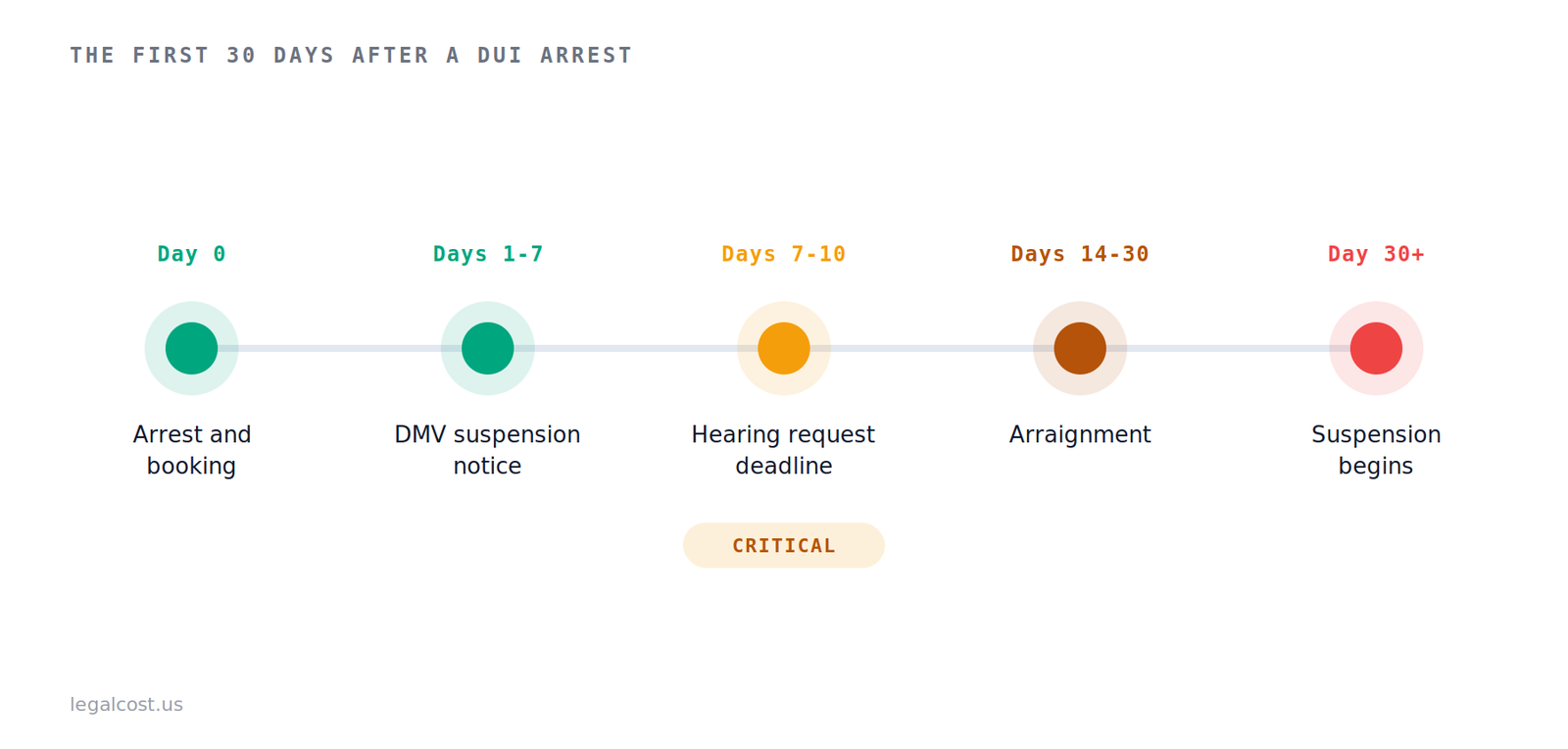
-
Day 0Arrest, booking, release
You are arrested, processed, and either released on your own recognizance or after posting bail. Your car has been towed.
-
Days 1-7Administrative license suspension notice
In most states, the arresting officer confiscates your physical license and issues a temporary driving permit valid for 7 to 30 days. A suspension notice goes to the DMV automatically.
-
Days 7-10DMV hearing request deadline
This is the single most critical deadline that most people miss. You typically have 7 to 10 days from arrest to request an administrative hearing to contest your license suspension. In California, the deadline is 10 days. In Texas, it is 15 days. In Florida, 10 days. Miss this window and your license is suspended automatically, often before your criminal case even starts.
-
Days 14-30Arraignment
Your first court appearance. You will hear the formal charges and enter a plea of guilty, not guilty, or no contest. Most defense attorneys advise pleading not guilty at arraignment regardless of the circumstances, to preserve room for negotiation.
-
Days 30-90Administrative license suspension begins
If you did not contest the DMV suspension, or your hearing was unsuccessful, your license is suspended during this period. This happens even while your criminal case proceeds separately.
-
Month 2-6Pre-trial motions and plea negotiations
Your attorney files motions, reviews police reports and breathalyzer calibration records, and negotiates with the prosecutor. Most first-offense DUI cases resolve at this stage without going to trial.
License Suspension After a DUI
Here is something most people do not realize until it is too late: there are two separate suspension processes running in parallel after a DUI arrest.
Administrative Suspension: This Happens Before Court
The administrative suspension is handled entirely by your state's DMV or motor vehicle agency, not the court. It starts automatically the moment the arresting officer reports your arrest and BAC result. This process is completely separate from the criminal case. You can win your criminal DUI case and still have your license suspended by the DMV.
That is why the DMV hearing request deadline matters so much. The window to request a hearing is narrow, typically 7 to 10 days in most states. If you file the request in time, your license generally stays valid until the hearing is held.
Court-Ordered Suspension: This Comes at Sentencing
If you are convicted of DUI (or plead to a lesser charge that includes a suspension), the court imposes a separate suspension as part of your sentence. In some states, the administrative and court suspensions run concurrently. In others, they stack, meaning you could serve both in sequence.
Hardship License
Most states offer a restricted or hardship license that lets you drive to specific destinations: work, school, medical appointments, and court-ordered programs. Getting one usually involves applying through the DMV, paying a fee, and in many states installing an ignition interlock device on your vehicle. Requirements and waiting periods vary widely by state.
First DUI Penalties by Category
Fines and Court Costs
The fine amount printed in a state statute is almost never what you actually pay. Courts add penalty assessments, surcharges, and administrative fees that can double or triple the bill. A statutory fine of $500 can arrive as a total of $1,200 to $2,500 once all the add-ons are included.
| State | Jail Time | Fine Range | License Suspension | IID Required |
|---|---|---|---|---|
| California | Up to 6 months | $390-$1,000 + fees | 6-10 months | Yes (4 months) |
| Texas | Up to 180 days | Up to $2,000 | 90-365 days | Yes (case by case) |
| Florida | Up to 6 months | $500-$1,000 | 180 days-1 year | Yes (if BAC 0.15+) |
| New York | Up to 1 year | $500-$1,000 | Minimum 6 months | Yes (minimum 6 months) |
| Arizona | 10 days minimum | $1,250 minimum | 90 days-1 year | Yes (all first offenses) |
| Illinois | Up to 1 year | Up to $2,500 | 1 year | Yes (2026 expansion) |
| Georgia | 24 hours-1 year | $300-$1,000 | 1 year | Yes (for hardship permit) |
| Utah | 2 days minimum | $700 minimum | 120 days | Yes (18 months) |
| Virginia | Up to 12 months* | Minimum $250 | 1 year | Yes |
| Tennessee | 48 hours minimum | $350-$1,500 | 1 year | Yes (most cases) |
*Virginia: No mandatory minimum jail for a standard first offense. Mandatory minimums apply only for elevated BAC: 5 days for BAC 0.15-0.20%, 10 days for BAC above 0.20%.
Jail Time
Most first-time DUI offenders do not end up in state prison. For a standard first offense with nothing aggravating the charge, jail is measured in hours or days, not months. Many states allow alternatives that most judges prefer: probation, community service, house arrest, or enrollment in a DUI diversion program.
The exceptions are states with mandatory minimum sentences. Arizona requires 10 consecutive days in jail for a first offense, with no judicial waiver allowed. Tennessee requires 48 hours (increased to 7 days if your BAC exceeded 0.15%). Virginia imposes a mandatory minimum only when the BAC is 0.15% or higher. In these states, no amount of good lawyering eliminates the jail component entirely.
DUI vs. Wet Reckless: A Key Distinction
In many states, defense attorneys negotiate to reduce a DUI charge to "wet reckless," which is reckless driving involving alcohol. The difference matters. A wet reckless conviction generally carries lower fines, shorter or no license suspension, and may not trigger the same insurance rate increases. In some states, a wet reckless does not count as a prior DUI if you are charged again later. Not every case qualifies, but when the evidence is borderline, this is one of the primary reasons to hire an experienced DUI attorney.
Probation
Probation is standard for first DUI convictions and usually runs 1 to 3 years. During that time you are subject to conditions set by the court: no further alcohol-related offenses, sometimes no alcohol at all, regular check-ins with a probation officer, completion of DUI school, payment of fines, and community service hours. A violation of any condition, even something unrelated to alcohol, can result in the original jail sentence being imposed.
DUI School
Every state requires some form of alcohol education or DUI school as part of a first-offense sentence. The length varies. Some states mandate a weekend program. Others require a course lasting 12 weeks or more. In California, first-time offenders with a BAC under 0.15% complete a 3-month program. Higher BAC means a 9-month program. Cost ranges from $300 to $1,500. You pay for it out of pocket, and your license will not be reinstated until you finish.
Ignition Interlock Device (IID)
An ignition interlock device is a breathalyzer wired into your car's ignition system. You blow into it before starting the car and at random intervals while driving. If alcohol is detected, the car will not start. As of 2026, more than 20 states plus Washington D.C. require IIDs for all first-offense DUI convictions. Several additional states require them for high BAC cases or as a condition of getting a restricted license.
Installation runs $70 to $150, and monthly monitoring fees range from $60 to $100 depending on the provider and state. You cover the entire cost yourself. Required duration ranges from 6 months for a standard first offense to 2 years or more for high BAC cases.
How Much Will Your DUI Actually Cost?
Fines are just the beginning. See the real 3-year cost in your state: attorney fees, IID, insurance, all calculated instantly.
Calculate My DUI CostThe Full Cost of a First DUI
The court fine is the smallest line item. Here is what the real total looks like when every cost is accounted for.
| Cost Category | Low Estimate | High Estimate | Notes |
|---|---|---|---|
| Court fines and fees | $500 | $2,500 | Base fine plus all court assessments |
| DUI attorney | $1,500 | $5,000 | For a plea deal; trial costs more |
| Bail (if applicable) | $500 | $2,500 | Often returned minus bail bond fees |
| DUI school | $300 | $1,500 | Mandatory in all states |
| License reinstatement | $100 | $500 | Plus any SR-22 filing fee |
| Ignition interlock device | $800 | $1,500/year | If required; 6-18 months typical |
| Towing and impound | $100 | $500 | Immediate cost at arrest |
| Insurance increase (year 1) | $1,500 | $3,500 | Persists 3-5 years |
| Insurance increase (years 2-3) | $3,000 | $7,000 | Combined years 2 and 3 |
| Total 3-Year Cost | $9,300 | $24,500 | National average: ~$16,000 |
Sources: National Highway Traffic Safety Administration (NHTSA), Insurance.com Rate Analysis 2026, state court fee schedules. Updated October 2026.
Long-Term Consequences of a DUI
The fines get paid. The suspension ends. But the conviction stays.
How Long Does a DUI Stay on Your Record?
A DUI stays on your driving record for 7 to 11 years depending on the state. California, Florida, and most states use a 10-year lookback period, meaning a second DUI within that window is treated as a repeat offense with much harsher penalties. Virginia keeps a DUI on your driving record for 11 years. On your criminal record, a DUI misdemeanor conviction is permanent unless you qualify for expungement. For a detailed state-by-state breakdown, see our guide on how long a DUI stays on your record.
Expungement is available in some states for first-time DUI misdemeanor convictions, but the eligibility requirements are strict. You must have completed all sentencing requirements, paid all fines, and waited a specified period, often 3 to 7 years after the conviction date. Even a successfully expunged DUI remains visible to law enforcement and may show up in certain background check contexts.
Auto Insurance: The Cost That Keeps Going
Insurance is where a DUI does the most financial damage over time. A single conviction raises your annual premium by 50 to 100 percent in most states. Some insurers cancel your policy outright, forcing you into the high-risk (non-standard) market at even higher rates. These increases persist for 3 to 5 years after the conviction date, not the arrest date or sentencing date.
You will also need to file an SR-22 form with your state's DMV. An SR-22 is a certificate your insurance company files on your behalf to confirm you carry the state's minimum required coverage. It is not additional insurance. It costs $15 to $50 to file. If your insurer drops you, you need to find a new insurer willing to take on a high-risk driver before your SR-22 requirement lapses.
Employment
A DUI conviction appears on criminal background checks. How it affects your job depends heavily on your profession and your employer. Jobs that involve driving (delivery, trucking, rideshare, company vehicles) are the most directly affected. Professional licenses in nursing, medicine, law, teaching, and finance all have reporting and disclosure requirements that vary by state licensing board. A Commercial Driver's License (CDL) is effectively revoked for at least one year after a first DUI, and the career consequences for professional truck drivers are severe.
Private employers have wide latitude in how they handle DUI convictions. Many larger employers have written policies that treat a DUI as grounds for termination. Others decide case by case. The trend toward universal background checks means more employers will see a DUI conviction than was the case even ten years ago.
International Travel
Canada treats a DUI, even a US misdemeanor, as a serious criminal offense under Canadian law. This makes you inadmissible at the border. It catches many Americans completely off guard. To enter Canada with a DUI on your record, you need either a Temporary Resident Permit (apply at least 6 months before travel) or Criminal Rehabilitation (available 5 years after completing your sentence, $200 application fee, takes 12 to 18 months to process).
Most European countries do not automatically bar entry for a US DUI misdemeanor, though customs officers have discretion. The UK and Australia may deny entry. Japan and several other countries conduct thorough criminal record checks and may turn you away at the border.
What Makes a DUI Worse
A standard first-offense DUI is serious enough on its own. These factors can push it into significantly harsher territory.
- High BAC (0.15% or higher): Most states impose enhanced penalties when the BAC is well above the legal limit. California requires a longer DUI school program. Several states add mandatory minimum jail time. Fines and IID requirements increase across the board.
- Refusing a breathalyzer: Refusal carries automatic suspension in every state, typically longer than the DUI suspension itself. The refusal can be introduced at trial as evidence of consciousness of guilt.
- DUI with a minor passenger: Having a child in the vehicle when arrested for DUI is an aggravating factor in every state. Several states charge it as a separate offense, child endangerment, which can be a felony.
- DUI causing an accident: Any accident while impaired, even a minor collision, makes the case significantly more serious. Injury to another person can elevate a misdemeanor DUI to a felony, with sentences measured in years rather than days.
- DUI in a school zone or work zone: Most states double fines for DUI in designated school or construction zones.
- Prior offenses, even old ones: Many states have 10-year lookback periods. An older DUI conviction outside that window may not count as a prior offense. But states with lifetime lookback periods, like Virginia, treat even a 20-year-old conviction as a prior.
Need Someone to Handle Things for You?
A power of attorney lets a person you trust deal with bills, your car or work matters while your case is under way. For the charge itself, speak with a DUI attorney as early as you can.
Prepare your Power of Attorney on LawDepotAffiliate link: LegalCost.us earns a commission from LawDepot at no extra cost to you.
Do You Need a DUI Lawyer for a First Offense?
In almost every case, yes. The exceptions are rare: a case where the evidence against you is extremely weak, or a jurisdiction with a clearly structured diversion program that applies to your exact situation.
Here is what an experienced DUI attorney actually does for you. They obtain and review the police dashcam and bodycam footage. They pull the breathalyzer's calibration and maintenance records, because improperly maintained devices produce inadmissible results. They review the chain of custody for any blood samples. They analyze whether the traffic stop itself was legally justified. If any of these elements are flawed, the charge can be reduced or dismissed entirely.
Even when the evidence is solid, an attorney can negotiate a plea to a lesser charge. In many states, that means wet reckless (reckless driving involving alcohol), which carries lower fines, shorter or no license suspension, and may not count as a prior DUI offense in some jurisdictions.
Attorney fees for a first DUI plea deal typically run $1,500 to $5,000. In many cases, the money saved on fines, reduced insurance costs, and avoided collateral consequences makes that investment clearly worthwhile.
Sources: the National Highway Traffic Safety Administration for impaired-driving data, and state statutes for the penalties. The total cost figures are assembled from the individual costs listed above rather than taken from a published study of what a DUI costs, because no such study is cited here; treat them as a rough envelope. Reviewed October 2026.
Frequently Asked Questions
Can you go to jail for a first DUI?
Yes, jail time is possible even for a first DUI. Most states allow up to 6 months in county jail for a first offense, though many judges substitute jail with probation, community service, or a DUI diversion program. Arizona, Tennessee, and a handful of other states have mandatory minimum jail sentences that a judge cannot waive, even for a first offense with no prior record.
How long does a DUI stay on your record?
In most states, a DUI stays on your driving record for 7 to 10 years and on your criminal record permanently unless expunged. California, Florida, and several others use a 10-year lookback period. Virginia keeps a DUI on your driving record for 11 years. Expungement eligibility depends on your state, whether you completed all court requirements, and whether the charge was a misdemeanor or felony.
How much does a first DUI cost?
A first DUI typically costs between $10,000 and $25,000 over three years when all expenses are added up. This includes court fines ($500 to $2,500), attorney fees ($1,500 to $5,000), DUI school ($300 to $1,500), license reinstatement ($100 to $500), ignition interlock device costs if required ($950 to $1,400 per year), and auto insurance increases of $1,500 to $3,500 per year for three or more years. Use our free DUI Cost Calculator to get your state-specific estimate.
Will a DUI affect my job?
A DUI can affect your job in several ways. Employers who run background checks will see a DUI conviction. Jobs that require driving, professional licenses (nursing, law, teaching, CDL), or security clearances are at particular risk. Some employers have written policies that make a DUI grounds for termination. Government and law enforcement jobs are the most difficult to retain or obtain with a DUI on record.
Can I refuse a breathalyzer?
You can physically refuse, but refusing triggers automatic consequences in every state. Under implied consent laws, driving on public roads means you have already agreed to chemical testing when an officer has probable cause to believe you are impaired. Refusal typically results in automatic license suspension of 6 to 12 months, often longer than the suspension for a first DUI conviction. Refusal can also be used against you in court as evidence of consciousness of guilt.
What is the difference between a DUI and a DWI?
DUI (Driving Under the Influence) and DWI (Driving While Intoxicated) are terms different states use for the same or similar offenses. Some states use both, with DWI indicating a higher BAC and carrying more severe penalties. The legal BAC limit in all US states is 0.08% for drivers over 21. Utah uses 0.05%. Commercial drivers face a 0.04% limit, and drivers under 21 face zero-tolerance laws in most states.
Do I need a lawyer for a first DUI?
While not legally required, an attorney is strongly recommended. A DUI attorney can review whether the traffic stop was legally justified, challenge breathalyzer calibration records, negotiate for reduced charges or dismissal, and help you navigate collateral consequences. For a first offense where dismissal or a plea to a lesser charge is possible, attorney fees usually pay for themselves in reduced fines, avoided suspension, and lower long-term insurance costs.
How long will my license be suspended after a DUI?
License suspension for a first DUI typically ranges from 90 days to one year depending on your state. Most states impose two separate suspensions: an administrative suspension by the DMV that begins within days of arrest, and a court-ordered suspension at sentencing. In many states you can apply for a restricted or hardship license that allows driving to work, school, and medical appointments during the suspension period.
Can a DUI be expunged?
Expungement eligibility varies by state. California allows expungement of a first DUI misdemeanor after completing probation. Texas does not allow expungement of DUI convictions but may allow an order of non-disclosure for certain first offenders. Some states allow the record to be sealed. Felony DUIs involving injury or death are generally not expungeable. An expungement does not remove the DUI from your driving record or prevent insurance companies from seeing it.
Can I travel to Canada with a DUI?
A DUI conviction can make you inadmissible to Canada, which treats DUI as a serious criminal offense under Canadian law. Even a misdemeanor DUI from the US may bar entry. To enter Canada with a DUI, you generally need to apply for a Temporary Resident Permit (at least 6 months before travel) or Criminal Rehabilitation (available 5 years after completing your sentence). A DUI does not automatically bar entry to most European countries, though the UK and Australia may deny entry at their discretion.
See the Real Cost of a DUI in Your State
Our free calculator uses official state data to show your exact total: fines, attorney, insurance, IID, all in one number.
Calculate My DUI Cost