Most people asking this question are asking the wrong version of it. A DUI does not sit on one record with one expiration date. It sits on three separate systems, each with its own clock, and those clocks almost never match. Knowing which one you are actually asking about is the difference between planning your next five years accurately and worrying about the wrong thing entirely.
Disclaimer: This guide is for informational purposes only and is not legal advice. Record retention and expungement rules vary by state and change frequently. Consult a licensed attorney in your state for advice about your specific situation.
A DUI stays on your driving record for 5 years to permanently depending on the state, with most states using 7 to 10 years. It stays on your criminal record permanently unless expunged. The sentencing lookback period, which decides whether a new DUI counts as a repeat offense, is typically 10 years but ranges from 5 years in Mississippi to lifetime in Texas, Colorado, and Pennsylvania. Insurers usually look back 3 to 5 years when pricing your policy.
Three Records, Three Different Clocks
When someone says a DUI stays on your record for ten years, they are usually talking about one system and accidentally implying all three. Here is what actually exists.
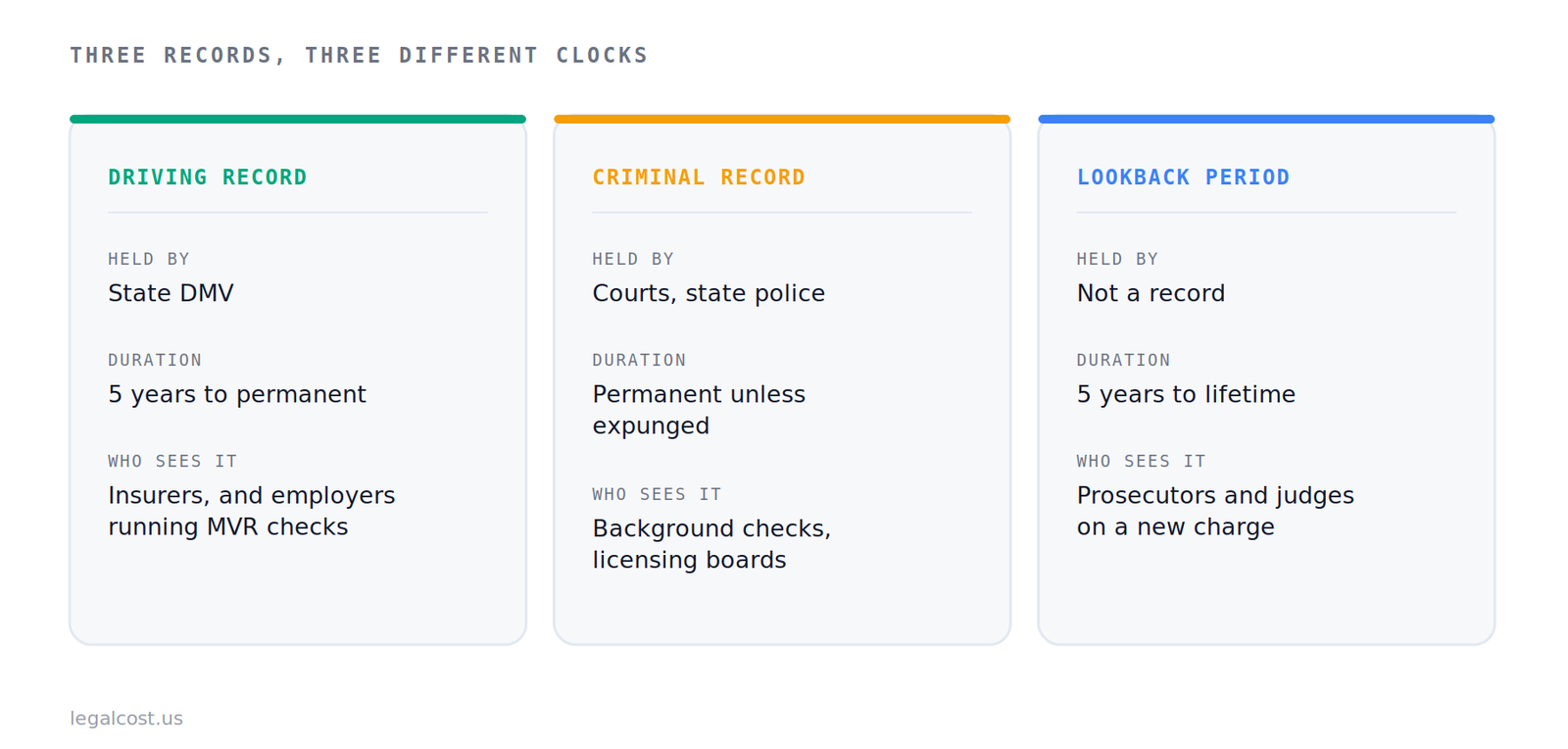
Held by your state DMV. This is what insurers pull and what employers see when they run a motor vehicle report. Retention: 5 years to permanent.
Held by courts and state police. Shows on background checks. Retention: permanent in every state unless expunged or sealed.
Not a record at all. It is a sentencing rule that decides whether an old DUI makes a new one a repeat offense. Range: 5 years to lifetime.
These systems operate independently. A DUI can fall off your driving record in Ohio after five years while still sitting on your criminal record permanently. You can successfully expunge a DUI from your criminal record in California and still have the DMV entry visible to insurers for the full retention period. And in Texas, a DUI from 1998 still counts against you for sentencing purposes today, even though most people would assume something that old had long since stopped mattering.
How Long a DUI Stays on Your Driving Record
Your driving record, formally the motor vehicle record or MVR, is maintained by your state licensing agency. It lists violations, suspensions, points, and convictions tied to your license. This is the record that determines your insurance rate and that shows up when an employer runs a driving check for a position that involves operating a vehicle.
Retention periods here vary enormously. The national norm is 7 to 10 years, but the outliers are dramatic.
| State | Driving Record Retention | Sentencing Lookback | Notes |
|---|---|---|---|
| Florida | 75 years | 5 yrs (2nd), 10 yrs (3rd) | Effectively permanent for most drivers |
| Texas | Permanent | Lifetime | All prior DWIs count forever |
| Illinois | Permanent | Lifetime | No expungement for DUI convictions |
| Pennsylvania | Permanent | 10 years | Record stays, lookback is limited |
| Virginia | 11 years | 10 years | Retention exceeds lookback window |
| California | 10 years | 10 years | Expungement available after probation |
| Utah | 10 years | 10 years | Lowest BAC threshold in the US at 0.05% |
| Arizona | Permanent | 7 years | Mandatory jail on first offense |
| Michigan | Permanent | 7 yrs (2nd), lifetime (3rd+) | Escalating lookback structure |
| Mississippi | 5 years | 5 years | Shortest lookback window in the country |
Sources: State DMV record retention schedules, Governors Highway Safety Association (GHSA), National Highway Traffic Safety Administration. Verified July 2026. Retention rules change; confirm with your state DMV before making decisions based on these figures.
Florida is the number that surprises people. A DUI conviction remains on a Florida driving record for 75 years. For anyone convicted after their early twenties, that is functionally permanent. Florida separates this from its sentencing lookback, which is 5 years for a second offense and 10 years for a third, so an old DUI may stop enhancing your sentence long before it stops appearing on your record.
How Long a DUI Stays on Your Criminal Record
This one has a short answer: forever, unless you do something about it.
Criminal records do not expire. There is no state where a DUI conviction automatically drops off your criminal history after a set number of years. The conviction sits there permanently until it is expunged, sealed, set aside, or vacated through a formal legal process, and in many states that process is not available for DUI at all.
What does change over time is who looks and how far back they look. Many employers voluntarily limit background checks to the past seven or ten years. Several states restrict how far back employers may inquire. The Fair Credit Reporting Act limits consumer reporting agencies to seven years for arrests that did not lead to conviction, but places no time limit on reporting actual convictions. So the record is permanent, but its practical visibility often fades.
Expungement: Who Can and Cannot
Expungement rules for DUI split states into roughly three groups.
States that allow it. California is the clearest example. A first DUI misdemeanor can be dismissed under Penal Code 1203.4 after successfully completing probation. The conviction is set aside, and for most private employment purposes you can legally answer that you have not been convicted. Several other states have comparable pathways with varying waiting periods.
States that allow a limited version. Texas does not permit expungement of a DUI conviction, but a first-time offender who received deferred adjudication may qualify for an order of non-disclosure, which seals the record from most private employers while keeping it visible to law enforcement and certain licensing bodies. Maryland created a narrow pathway in 2024 allowing expungement of a DUI resolved through Probation Before Judgment after 15 years with no new convictions.
States that prohibit it. Illinois does not allow expungement or sealing of DUI convictions under any circumstances. Several other states have similar categorical bars. In these states, the only records that can be cleared are arrests that did not result in conviction, dismissals, and acquittals.
Lookback Periods: The Clock That Decides Your Next Sentence
The lookback period is not a record retention rule. It is a sentencing rule, and it is the one that carries the highest stakes if you ever face a second charge.
Here is why it matters. A first DUI is typically a misdemeanor with fines, probation, and a license suspension measured in months. A second DUI within the lookback window brings mandatory jail time in most states, suspensions measured in years, mandatory ignition interlock, and in several states, felony exposure by the third offense. The difference between a prior that counts and a prior that has washed out is often the difference between probation and prison.
Consider a driver with a DUI conviction in 2015 who is arrested again in 2026:
- In Mississippi, with a 5-year lookback, the 2015 conviction has washed out. The 2026 arrest is charged as a first offense.
- In Arizona, with a 7-year lookback, it has also washed out.
- In California or Virginia, with 10-year lookbacks, the 2015 conviction falls just outside the window. Timing matters to the month.
- In Texas, Colorado, or Pennsylvania, with lifetime lookbacks, the 2015 conviction absolutely counts. The 2026 arrest is a second offense with all the enhanced penalties that carries.
States with Escalating Lookback Periods
Several states apply different lookback windows depending on which offense number is at issue. Michigan uses a 7-year lookback for a second OWI but a lifetime lookback for a third or subsequent offense. Florida uses 5 years for a second DUI and 10 years for a third. Alabama and North Dakota both use lookback periods that lengthen with each additional offense. These structures mean that a prior conviction can be irrelevant for one charge and decisive for the next.
Watch how your state measures the window. Some states measure offense date to offense date. Others measure conviction date to offense date. If your prior conviction came a year after the arrest, that gap can move you inside or outside the window. When a lookback boundary is close, this technical detail is worth an attorney consultation before you assume anything.
Fines are a fraction of it. See the full three-year cost in your state including attorney fees, ignition interlock, and insurance increases.
Calculate My DUI CostHow Long a DUI Affects Your Insurance
Insurance runs on its own timetable, and it is usually shorter than the record retention period. Most carriers use a 3 to 5 year lookback when pricing a policy. During that window, a DUI typically increases premiums by 50 to 100 percent, and some carriers decline to renew the policy entirely, pushing you into the non-standard or high-risk market where rates run higher still.
Once the DUI falls outside the carrier lookback window and you have accumulated no new violations, rates generally begin to come down. This is the practical reason the driving record retention period matters less than people assume for insurance purposes. A DUI that stays on a Florida record for 75 years does not mean 75 years of surcharges.
The exception worth knowing: some carriers tie their surcharge to the record rather than to a fixed window, meaning the surcharge persists as long as the violation appears on the MVR. In permanent-record states, that can mean the surcharge never expires with that particular carrier. Shopping for new coverage once you pass the three to five year mark is often the single most effective way to reduce the cost.
Most states also require an SR-22 filing after a DUI, which is a certificate your insurer files with the state confirming you carry minimum required coverage. The filing itself costs $15 to $50. The real cost is that carrying an SR-22 marks you as high-risk, and the requirement typically lasts 3 years.
Sources: Insurance Information Institute, Insurance.com rate analysis, state SR-22 filing requirements. Updated July 2026.
DUI on Background Checks and Employment
A DUI conviction shows on a standard criminal background check indefinitely unless expunged. Whether it costs you a job depends far more on the role and the employer than on how old the conviction is.
Roles involving driving are the most directly affected, because the employer is pulling your MVR rather than just a criminal check. Delivery, trucking, rideshare, and any position with a company vehicle will surface the DUI as long as it remains on the driving record.
Commercial drivers face the harshest rules, and they are federal rather than state. A first DUI conviction disqualifies a CDL holder for one year, or three years if the driver was hauling hazardous materials at the time. A second conviction results in lifetime disqualification, with a possible reinstatement petition after ten years in some circumstances. These rules apply even if the DUI occurred in a personal vehicle on a day off.
Licensed professions including nursing, medicine, law, teaching, and financial services all carry disclosure obligations to their licensing boards. Requirements vary by state and board. A DUI rarely ends a licensed career on its own, but failing to disclose one when required frequently does.
Security clearances treat a single DUI as a manageable issue and a pattern of alcohol-related incidents as a serious one. Disclosure is mandatory and non-disclosure is disqualifying.
DUI and International Travel
Canada is the one that catches Americans off guard, because the border consequence has nothing to do with how long the DUI stays on your US record. Canadian law treats impaired driving as a serious criminal offense, and a conviction can render you inadmissible at the border regardless of whether it was charged as a misdemeanor at home.
Two pathways exist. A Temporary Resident Permit allows entry for a specific purpose and should be applied for at least six months before travel. Criminal Rehabilitation is the permanent solution and becomes available five years after you complete your entire sentence, including probation and payment of all fines. Processing takes twelve to eighteen months.
Most of Europe does not bar entry for a US DUI misdemeanor, though border officers retain discretion. The United Kingdom and Australia both conduct character assessments that can result in refusal. Japan and several Asian countries conduct thorough criminal record checks at entry.
A power of attorney lets a person you trust deal with bills, your car or work matters while a DUI case runs. Record clearing rules vary by state, so ask a DUI attorney about eligibility.
Prepare your Power of Attorney on LawDepotAffiliate link: LegalCost.us earns a commission from LawDepot at no extra cost to you.
What You Can Actually Do About It
The record itself is largely fixed, but a few things are within your control.
Check your eligibility for expungement or sealing. This is state-specific and worth an hour of an attorney's time to assess properly. If you are eligible and have completed all sentencing requirements, the process is often straightforward and the benefit is permanent.
Complete every court requirement fully and on time. Expungement eligibility almost always requires full completion of probation, DUI school, community service, and payment of all fines. An unpaid balance from years ago can block a petition.
Shop your insurance annually after year three. Carriers differ substantially in how they weight an aging DUI. The carrier that rated you after the conviction is often not the cheapest option once you are three years out with a clean record.
Know your lookback boundary exactly. If you are near the edge of your state's window, that date is worth knowing precisely. It is not a reason to take risks, but it is relevant information if you are ever advising on the timing of a legal decision.
Request your own records. You can order your MVR from your state DMV for a small fee and run a self-background check. Errors happen, and an incorrectly recorded disposition is far easier to fix once you know it exists.
Sources: State expungement statutes, Federal Motor Carrier Safety Administration CDL disqualification rules (49 CFR 383.51), Immigration and Refugee Protection Act (Canada). Updated July 2026.
Frequently Asked Questions
How long does a DUI stay on your driving record?
Driving record retention ranges from 5 years to permanent depending on the state. Most states keep a DUI on the motor vehicle record for 7 to 10 years. Florida keeps it for 75 years. Illinois, Texas, Pennsylvania, and several other states keep it permanently. Virginia keeps it for 11 years. This is the record that insurers and employers who run driving checks will see.
How long does a DUI stay on your criminal record?
A DUI conviction stays on your criminal record permanently in every state unless it is expunged, sealed, or set aside. Criminal records have no automatic expiration. This is separate from your driving record. Even in states where the DUI drops off the driving record after 10 years, the criminal conviction remains visible on background checks indefinitely unless you take legal action to remove it.
What is a DUI lookback period?
A lookback period, also called a washout period or priorability window, is how far back a court looks when deciding whether a new DUI counts as a repeat offense. If your prior DUI falls inside the window, the new charge is sentenced as a second or third offense with much harsher penalties. Lookback periods range from 5 years in Mississippi to lifetime in Texas, Colorado, and Pennsylvania. The national norm is 10 years.
Which states have a lifetime DUI lookback period?
Texas, Colorado, Pennsylvania, and Louisiana apply lifetime lookback periods, meaning any prior DUI counts regardless of how long ago it happened. Michigan uses a 7-year lookback for a second offense but a lifetime lookback for a third or subsequent offense. Several other states use escalating lookback periods that lengthen with each additional offense. Always check your specific state statute, as these rules change.
Can a DUI be expunged from your record?
Expungement eligibility varies significantly by state. California allows expungement of a first DUI misdemeanor after successfully completing probation. Texas does not allow expungement of DUI convictions but may permit an order of non-disclosure for certain first offenders. Maryland allows expungement of a DUI resolved through Probation Before Judgment after 15 years under its 2024 law. Illinois and several other states prohibit DUI expungement entirely. Felony DUIs involving injury or death are generally never expungeable.
Does an expunged DUI still show on my driving record?
Yes, in most states. Criminal expungement and driving record retention are separate systems. Expunging the criminal conviction does not remove the DUI from your DMV driving record. The DMV entry stays for its full statutory retention period, which means insurers and employers running a motor vehicle report will still see it. A few states allow separate petitions to amend driving records, but this is rare.
How long does a DUI affect car insurance?
Most insurers use a 3 to 5 year lookback window when pricing policies. During that window, a DUI typically raises premiums by 50 to 100 percent or more, and some carriers cancel the policy entirely. Once the DUI passes outside the insurer lookback window and you have no new violations, rates generally begin to decline. Some carriers extend surcharges until the DUI drops off the driving record entirely, which in permanent-record states means the surcharge never fully expires with that carrier.
Will a DUI show up on a background check?
Yes. A DUI conviction appears on criminal background checks indefinitely unless expunged or sealed. However, many employers only review the past 7 to 10 years of criminal history, and several states restrict how far back employers may look. The Fair Credit Reporting Act limits some consumer reporting agencies to 7 years for non-conviction records, but conviction records have no federal time limit.
Does a DUI affect a CDL permanently?
A first DUI conviction disqualifies a commercial driver from operating a commercial vehicle for at least one year under federal regulation, or three years if the driver was transporting hazardous materials. A second DUI conviction results in lifetime CDL disqualification under federal rules, though some drivers may apply for reinstatement after 10 years. These federal rules apply regardless of whether the DUI occurred in a personal or commercial vehicle.
Does the clock start at arrest or conviction?
It depends on the state and the record type. Most states start the driving record retention clock on the date of the violation or the date of conviction. Lookback periods are usually measured from offense date to offense date, though some states measure from conviction date to offense date, which can change whether a prior counts. Insurance lookback is typically measured from the conviction date or the date the violation appeared on the motor vehicle record. This distinction can matter significantly if your prior offense falls near the edge of a lookback window.
Court fines, attorney fees, ignition interlock, and three years of insurance increases, calculated with official state data.
Open the DUI Cost Calculator