
There are two things about divorce cost figures that almost never get explained upfront. First, the numbers you see quoted are almost always per spouse, which means a divorce quoted at $15,000 is actually pulling closer to $30,000 out of the household. Second, legal fees alone account for only about 60 to 70 percent of what you will really spend. This guide covers both sides of that equation, breaks down each process path and what it truly costs, and shows you where the money actually goes.
Disclaimer: This guide is for informational purposes only and is not legal advice. Costs vary by state, county, attorney, and the specific facts of your case. Figures cited are ranges from published surveys and court fee schedules, not quotes. Consult a licensed family law attorney in your state.
A US divorce can cost anywhere from the filing fee alone (roughly $85 to $435 depending on the state) all the way up to $100,000 or more per side in high-conflict cases. According to a 2019 Martindale-Nolo survey, the mean cost with attorney representation comes in around $11,300 per spouse, while the median sits closer to $7,000. That means most people pay less than the "average" would suggest. An uncontested case typically runs $500 to $3,500 total. Mediation runs $3,500 to $12,000 all in. Full litigation pushes into $15,000 to $30,000 per spouse territory. Try our free Divorce Cost Calculator for a figure based on your state and situation.
The Two Things Most Cost Guides Get Wrong
Search for "how much does a divorce cost" and you will find a number somewhere between $10,000 and $15,000 cited as the national average. That figure is not exactly wrong, but the way it gets presented leads people to make two costly miscalculations.
The number is usually per spouse
When a survey says a contested divorce costs $15,000, that is what one spouse paid their own legal team. The other spouse is running up a separate tab with their own attorney. If you are trying to figure out how much money is actually leaving the household, you need to roughly double whatever number you see quoted.
This matters most in contested cases, where the billing works against you from both directions. Every motion one attorney files, the other attorney bills time to respond to. Every deposition one side takes, the other side's lawyer attends and bills. Conflict in a divorce is expensive twice over, and that is the part nobody thinks about until the invoices arrive.
The average is skewed, and the median tells a truer story
A 2019 Martindale-Nolo survey put the mean cost of a divorce with attorney representation at about $11,300, and the median at roughly $7,000. That $4,300 gap between the two exists because a relatively small number of very expensive contested cases pull the average way up. If your situation is reasonably straightforward and you and your spouse can find common ground on the major issues, you are much closer to that median number than you are to the mean.
Five Cost Paths, One Outcome
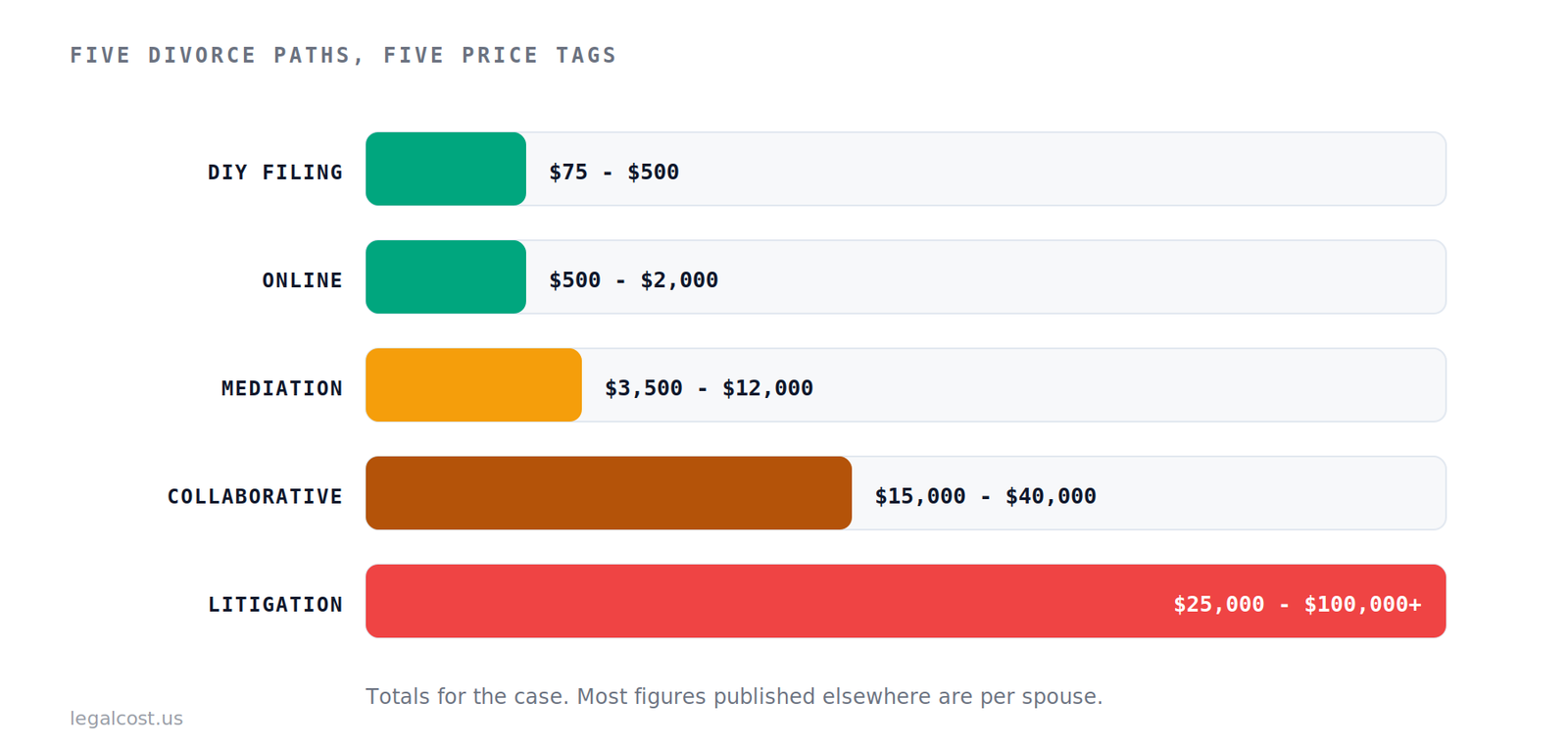
Every divorce ends the same way: with a signed decree. What varies enormously is the route you take to get there. These are the five distinct paths, and the cost spread between the cheapest and the most expensive is wider than most people expect.
DIY Filing
This is the simplest and cheapest path. Both spouses agree on everything, they complete the state forms on their own, and they file. The total cost is the filing fee plus a few dollars for certified copies. It works when there are no children, no shared property of significant value, no retirement accounts to divide, and no disagreement on anything. Those conditions are rarer than people assume, but when they genuinely hold, this path keeps the cost under $500.
Online Service
Document preparation services like those offered by several established online platforms handle the paperwork correctly and often submit the filing as well. Prices commonly start around $499 and go up from there depending on the complexity. What you are paying for is accuracy on the forms. A rejected filing costs you time, and some courts charge a refiling fee. What you are not paying for is legal advice. No online service can tell you whether the agreement you have reached with your spouse is actually fair to you.
Mediation
A neutral mediator helps both of you negotiate the terms of the divorce. The mediator's fee is typically split between both spouses, which is the comparison detail most people miss. A $6,000 flat-fee mediation package works out to $3,000 each. That is the number you should be comparing against what it would cost to hire separate attorneys.
The all-in figure of $3,500 to $12,000 includes the mediator, a review attorney for each spouse to check the agreement before anyone signs, and the court filing fee.
Collaborative Divorce
Each spouse hires a collaboratively trained attorney, and both sides sign an agreement committing to settle the case without going to court. The team often includes neutral financial planners and child specialists when needed. Total costs across the full team typically run $15,000 to $40,000, working out to roughly $8,000 to $15,000 per spouse. Most collaborative cases resolve within four to eight months.
There is a structural catch worth understanding before you commit to this path. If the collaboration fails and the case moves to litigation, both collaborative attorneys are automatically disqualified from representing their clients going forward. Both spouses have to find and pay new lawyers. That rule exists to give everyone at the table a strong incentive to reach a deal, and it generally works. But it means a failed collaborative process is expensive in a way that feels particularly painful.
Litigation
This is the path most people picture when they hear "divorce." Each spouse has their own attorney. There is formal discovery, depositions, motions, and either a negotiated settlement right before trial or the trial itself. Most litigated cases do settle before trial. Costs commonly run $15,000 to $30,000 per spouse when the case settles, and considerably more when it does not.
Nolo survey data is useful here for calibration. Their research shows the average cost of a divorce with attorney representation is about $11,300, with the median around $7,000. Divorces involving trial issues pushed the average to $20,400 or more. That gap between settling and going to trial is where most of the financial damage happens.
Our calculator uses your state's filing fee, local attorney rates, and your specific circumstances instead of a national average.
Open the Divorce Cost CalculatorCourt Filing Fees by State
The filing fee is the one cost that no one can avoid. It is also the smallest line item in most divorces, which is why it probably deserves less attention than it typically gets. Still, the spread between states is significant, and it helps to know where your state falls.
| Jurisdiction | Approximate filing fee | Note |
|---|---|---|
| Wyoming | $85 | Among the lowest in the country |
| Virginia | $86 | |
| Vermont | $90 | Uncontested with a stipulation; $295 contested |
| Mississippi | $148 - $160 | Varies by Chancery Court district |
| Average across states | $230 | Roughly; counties vary |
| Minnesota | about $400 | Base fee plus surcharges; check your county |
| Florida | about $400 - $410 | Among the highest statewide |
| California | $435 | Most populous counties |
| North Dakota | $160 | Raised from $80 in July 2025 |
Two details that catch people off guard. First, fees are often set at the county level rather than statewide, so your county may charge more or less than the figure listed for your state. Second, in most states the responding spouse also has to pay a first appearance fee, typically the same amount, unless the case proceeds by default. That means the true filing cost for the household is often double the number on the fee schedule.
Sources: State and county court fee schedules, Hello Divorce filing fee survey, National Center for State Courts. Updated September 2026. Fees change and vary by county. Always confirm with your local clerk before filing.
What Attorneys Actually Charge
Attorney fees are the single largest controllable cost in most divorces. The pricing structure is worth understanding before your first consultation, because it directly affects how you manage the relationship and the bill.
Hourly Rates
Family law attorneys charge $260 to $450 per hour nationally. In major metropolitan areas like New York, Los Angeles, San Francisco, and Chicago, $400 to $700 per hour (or more) is common. Rates track experience and location more than they track outcome quality. The most expensive attorney in town is not automatically the right choice for a straightforward case, and a less expensive attorney who handles cases like yours every week may actually serve you better.
Retainers
Most attorneys require an upfront retainer of $3,000 to $7,500. This is not a flat fee. It is a deposit held in a trust account and drawn down as the attorney bills hours against it. When the retainer gets low, you are typically required to replenish it. A $5,000 retainer at $350 per hour buys you roughly fourteen hours of work. In a contested case, that can get used up faster than you expect.
Flat Fees
A growing number of attorneys offer flat fees for uncontested divorces, commonly $1,000 to $3,500, covering document preparation and filing. If your case is genuinely uncontested, this is usually better value than an hourly arrangement, because it caps your exposure and removes the anxiety of watching a meter run.
Ask for an hours estimate, not just a rate. An hourly rate by itself tells you almost nothing about total cost. A $300 per hour attorney who needs forty hours costs more than a $450 per hour attorney who needs twenty. Any credible attorney will give you a realistic range of total hours for your specific case type. One who will not, or who quotes a suspiciously low estimate to win your business, is telling you something about how the engagement will go.
Specialists and Expert Costs
These are the costs that can turn a moderate divorce into an expensive one. They show up only when something in the case is genuinely complex or genuinely disputed, but when they do, they can add thousands quickly.
| Specialist | Typical cost | When needed |
|---|---|---|
| QDRO preparation | $500 - $2,000 per plan | Any 401(k) or pension being divided (IRAs split by a transfer order instead) |
| Residential appraiser | $400 - $1,000 | Property value disputed |
| Luxury property appraisal | $1,000 - $2,000 | High-value real estate |
| Business valuation | $5,000 - $25,000 | One spouse owns a business |
| Forensic accountant | $3,000 - $15,000 | Suspected hidden assets |
| Custody evaluator | $3,000 - $15,000 | Contested custody |
| CPA consultation | $150 - $400 per hour | Tax consequences of asset division |
| Child psychologist | $300 - $400 per hour | Contested custody, child interviews |
The QDRO line deserves special attention because it surprises almost everyone. A Qualified Domestic Relations Order is the legal mechanism that allows a retirement plan to be split between divorcing spouses without triggering early withdrawal penalties or an immediate tax bill. Without one, a 401(k) or pension cannot be divided. IRAs are different: they are split by a transfer under the divorce decree, with no QDRO needed. Each retirement plan requires its own separate order, drafted by a QDRO specialist and approved by both the court and the plan administrator. A couple with two 401(k)s and a pension needs three separate QDROs. That can run $1,500 to $6,000 in a cost category most people did not even know existed before their attorney mentioned it.
The Costs No Legal Estimate Includes
This is the section that most divorce cost guides skip entirely, and it is the main reason people are blindsided by their final number. When you add up everything, legal fees typically account for only about 60 to 70 percent of what a divorce actually costs. The rest is the price of untangling two lives that were financially woven together.
| Cost | Typical range |
|---|---|
| New housing deposit and setup | $3,000 - $8,000 |
| Separate health insurance | $300 - $800 per month |
| Mortgage refinancing to remove a spouse | $3,000 - $8,000 |
| QDRO preparation | $500 - $2,000 per plan |
| Updated estate documents (will, POA, beneficiaries) | $500 - $2,000 |
| Tax preparation changes | $200 - $500 |
| Therapy or counselling | $100 - $250 per session |
| Lost work productivity | 3 - 6 hours per week during proceedings |
When you add these up, they commonly tack on another 30 to 50 percent on top of the legal fees. A $15,000 legal bill frequently turns into $20,000 to $25,000 in real out-of-pocket cost once everything is counted.
The health insurance line is the one that hits hardest for most people. A spouse who was covered under the other's employer plan loses that coverage on the date the divorce is final. COBRA continuation coverage is available, but it is expensive, because you are now paying the full premium that the employer was previously subsidising. For families where one spouse was not working or was working part-time, this single cost can reshape their monthly budget overnight.
What Actually Drives the Number Up
Divorce cost scales almost entirely with conflict. Everything below is, at bottom, a different version of the same principle: disagreement costs money, and it costs it on both sides simultaneously.
Disagreement itself. Every issue you and your spouse cannot resolve privately becomes billable hours for both sides. Property division, custody, support, and the timeline are the four common battlegrounds. If you can settle even one of those before involving attorneys, you remove it from the bill entirely.
Children. Cases involving children cost 30 to 50 percent more than childless divorces. A parenting plan, custody arrangement, and child support calculation each require separate work and each creates a potential point of dispute. Parenting plans and support calculations add attorney hours even when both parents agree. Contested custody is where the costs really spike, because a custody evaluator alone can charge $3,000 to $15,000.
Business ownership. If one spouse owns a business, the business has to be valued. That valuation will almost certainly be contested by the other side. Business valuations run $5,000 to $25,000, and when the disputed value is large enough, both sides hire their own expert, effectively doubling that cost.
Suspected hidden assets. When one spouse believes the other is concealing money, the discovery process gets expensive fast. Subpoenas, forensic accountants, and formal depositions all cost real money. This is a situation where the expense is genuinely justified if the suspicion has a solid basis, and a significant waste if it does not.
Time. Because most attorneys bill hourly, duration and cost are really just two ways of looking at the same variable. An uncontested case can wrap up in 30 to 90 days plus any mandatory waiting period your state requires. Mediation typically runs two to four months. Collaborative divorce runs four to eight months. Contested litigation frequently stretches to a year or longer, and cases that go all the way to trial can take two to four years. Every additional month of dispute converts directly into billable hours for both sides.
When you both agree on the terms, preparing the paperwork yourself is the cheapest route there is. If you disagree on money or children, an hour with a family law attorney early on usually pays for itself.
Prepare your Divorce Papers on LawDepotAffiliate link: LegalCost.us earns a commission from LawDepot at no extra cost to you.
How to Spend Less
Some of the advice below sounds obvious once you read it. All of it is routinely ignored in practice, often because people going through a divorce are making financial decisions while under emotional pressure.
Choose the process deliberately. This is far and away the single largest lever you have. Mediation usually costs a fraction of litigation. Most people default into the litigation track because it is what they assume divorce means, not because they evaluated the alternatives and decided litigation was the best fit for their situation.
Settle what you can before hiring anyone. Every issue you and your spouse agree on privately is an issue no attorney needs to bill time on. Write down what you have agreed to. Bring that list to your first consultation. It narrows the scope of what the attorney needs to handle and directly reduces the cost.
Do your own document gathering. Tax returns from the last three to five years, bank statements, mortgage records, retirement account statements, credit card statements. All of it has to be collected and organised. Your attorney will happily do it for you at their hourly rate. You can do it for free on a Saturday afternoon.
Use email for anything that is not urgent. Many law firms bill in six-minute increments. That means a two-minute phone call costs the same as a ten-minute one. Batch your questions into a single email instead of calling five separate times. Over the life of a case, this small habit adds up to a real saving.
Hire experts only where the stakes justify the fee. A $5,000 business valuation makes financial sense when the disputed value is $200,000. It does not make sense when the disputed value is $15,000 and the valuation itself costs a third of what is at stake. Apply that same test to every specialist before agreeing to bring one on.
Watch the sunk cost trap. The most expensive divorces are not usually the ones with the most assets. They are the ones where one or both spouses decide they are going to "win." Spending $12,000 in legal fees to litigate a $4,000 disagreement is a depressingly common and entirely avoidable outcome. At every decision point, ask yourself whether the amount in dispute is worth the cost of fighting over it.
Sources: Martindale-Nolo divorce survey data, American Academy of Matrimonial Lawyers, state court fee schedules, National Center for State Courts. Updated September 2026.
Frequently Asked Questions
How much does a divorce cost on average?
A 2019 Martindale-Nolo survey put the mean cost of a divorce with attorney representation at roughly $11,300 per spouse, but the median is closer to $7,000. That gap matters because a minority of very expensive contested cases pull the average upward, so most people pay less than the headline number. An uncontested divorce handled without attorneys can cost as little as the filing fee, typically $85 to $435. A fully litigated divorce commonly runs $15,000 to $30,000 per spouse and can exceed $100,000 per side in high-asset, high-conflict cases.
How much does an uncontested divorce cost?
An uncontested divorce where both spouses agree on everything typically costs $500 to $3,500 total. That covers the state filing fee (about $85 to $435), document preparation ($150 to $1,500), and incidental court costs for certified copies. Couples who complete the forms themselves can finish for the filing fee alone. The same 2019 Martindale-Nolo survey found an uncontested divorce where both spouses hired attorneys averaged around $4,100.
How much are divorce filing fees by state?
The average divorce filing fee across states is roughly $230. Among the lowest are Wyoming at about $85, Virginia at $86, and Vermont at $90 for an uncontested filing. Among the highest are California at $435, Florida at about $400 to $410, and Minnesota at about $400. Most states also charge the responding spouse a separate first appearance fee, usually the same amount, unless the case proceeds by default.
How much do divorce lawyers charge per hour?
Family law attorneys charge $260 to $450 per hour nationally, rising to $400 to $700 or more in major metropolitan areas. Most require an upfront retainer of $3,000 to $7,500, which gets drawn down as work is billed and typically must be replenished when it runs low. Some attorneys offer flat fees for uncontested cases, commonly $1,000 to $3,500 covering document preparation and filing.
Is divorce mediation cheaper than litigation?
Substantially. Mediated divorces usually cost far less than litigated divorces with comparable assets, because most of the attorney hours never happen. A mediated divorce typically costs $3,500 to $12,000 all in, including the mediator, review attorneys for both spouses, and the filing fee. That works out to roughly $1,750 to $6,000 per person. The same case litigated and settled before trial commonly costs $25,000 to $60,000 total.
What hidden costs come with a divorce?
Legal fees are typically only 60 to 70 percent of the true total. The costs that no attorney estimate includes are things like new housing deposits and setup ($3,000 to $8,000), separate health insurance ($300 to $800 per month), mortgage refinancing ($3,000 to $8,000), QDRO preparation ($500 to $2,000 per retirement plan), updated estate documents ($500 to $2,000), tax preparation changes, and therapy. Together these commonly add 30 to 50 percent on top of the legal fees.
Does having children increase divorce costs?
Significantly. Divorces involving children typically cost 30 to 50 percent more because they require a parenting plan, custody arrangement, and child support calculation, each of which is a separate piece of work and a potential dispute. Parenting plans and support calculations add attorney hours even when both parents agree. Contested custody cases add the most cost, since a custody evaluator alone can charge $3,000 to $15,000.
What is a QDRO and why does it cost extra?
A Qualified Domestic Relations Order is a separate court order that allows a retirement plan to be divided between spouses without triggering early withdrawal penalties or an immediate tax bill. Without one, a 401(k) or pension simply cannot be legally split. Each plan requires its own QDRO, drafted by a specialist and approved by both the court and the plan administrator, at $500 to $2,000 each. A couple with three retirement accounts needs three separate QDROs.
How long does a divorce take and does that affect cost?
Time and cost are closely linked because most attorneys bill by the hour. An uncontested divorce can close in 30 to 90 days plus any statutory waiting period. Mediated cases commonly resolve in two to four months. Collaborative divorce takes four to eight months. Contested litigation frequently runs a year or more, and cases that reach trial can stretch to two to four years. Every additional month of dispute translates directly into more billable hours on both sides.
How can I reduce the cost of my divorce?
The single biggest lever is the process path you choose. Mediation usually costs a fraction of litigation. Beyond that: settle what you can before involving attorneys, since every agreed issue is one fewer billable dispute; gather your own financial documents rather than paying your attorney's hourly rate to collect them; batch questions into emails rather than making multiple phone calls, since many firms bill in six-minute increments; and hire specialists only when the disputed amount clearly exceeds the cost of the expert.
State filing fees, local attorney rates, and your case specifics instead of a national average. Free, no signup.
Calculate My Divorce Cost