
The first thing people ask when they call a personal injury lawyer is: what's your percentage? Fair question. But here's the thing most clients don't realize until the money arrives: the percentage is only one of four deductions between a settlement check and your bank account. And it's often not even the one that costs you the most. Two lines buried deeper in the same contract can swing thousands more than a couple of percentage points ever will.
Disclaimer: This guide is for informational purposes only and is not legal advice. Fee rules, statutory caps, and lien law vary by state and change. Figures cited are typical market ranges and published statutory limits, not quotes or predictions. Consult a licensed attorney in your state before signing any fee agreement.
Most personal injury lawyers charge 33 to 40 percent of whatever they recover for you. The standard split: 33.33% if the case settles before anyone files a lawsuit, 40% once litigation starts, and up to 45% if it goes all the way to trial. But the fee percentage alone doesn't tell you what lands in your pocket. Case costs eat another 3 to 10 percent, medical liens can take 10 to 30 percent, and a single clause about gross-vs-net calculation can move thousands of dollars. When all four deductions are done, most plaintiffs keep somewhere between 40 and 60 percent of the gross settlement. Try our free Attorney Fee Calculator to run your own numbers.
The Standard Tiers
Virtually every personal injury firm in the country works on contingency. You don't pay a dime upfront. The firm covers the costs, takes its cut from whatever it recovers, and if the case goes nowhere, you owe nothing for the lawyer's time.
What catches people off guard is that the percentage isn't a flat number. It ratchets up the further your case goes, because each stage demands more work and more financial risk from the firm.
Not every firm uses all four tiers. The 25-28% bracket is less common, but some practices offer it to lock in quick, low-effort resolutions. On the other end, 45% shows up in complex multi-defendant litigation or cases that survive to appeal. Even there, the fee has to pass a reasonableness test under your state's professional conduct rules.
The Line That Decides More Than the Percentage
Buried in every contingency agreement is one sentence most clients skip right over: whether the lawyer's percentage applies to the full recovery or to the amount left after case costs are paid back. People spend all their energy negotiating a percentage point here or there. This single clause is often worth more.
| Line item | Gross basis | Net basis |
|---|---|---|
| Settlement | $200,000 | $200,000 |
| Case expenses deducted first | no | − $20,000 |
| Amount the fee applies to | $200,000 | $180,000 |
| Attorney fee at 33.33% | − $66,660 | − $59,994 |
| Case expenses deducted after | − $20,000 | already deducted |
| Client keeps | $113,340 | $120,006 |
A difference of $6,666 to the client, decided by which word appears in one sentence of the contract.
The majority of standard agreements default to gross. That's not shady or unusual; it's just the industry norm. But it is negotiable. And in a case where the firm runs up $30,000 or $40,000 in expert fees and deposition costs, the gap between gross and net becomes very real money.
What Actually Comes Out of a Settlement
People hear a settlement number and think that's what they're getting. It's not. The attorney fee is just the first hand in the pile. Here's the full sequence, in the order your money actually leaves.
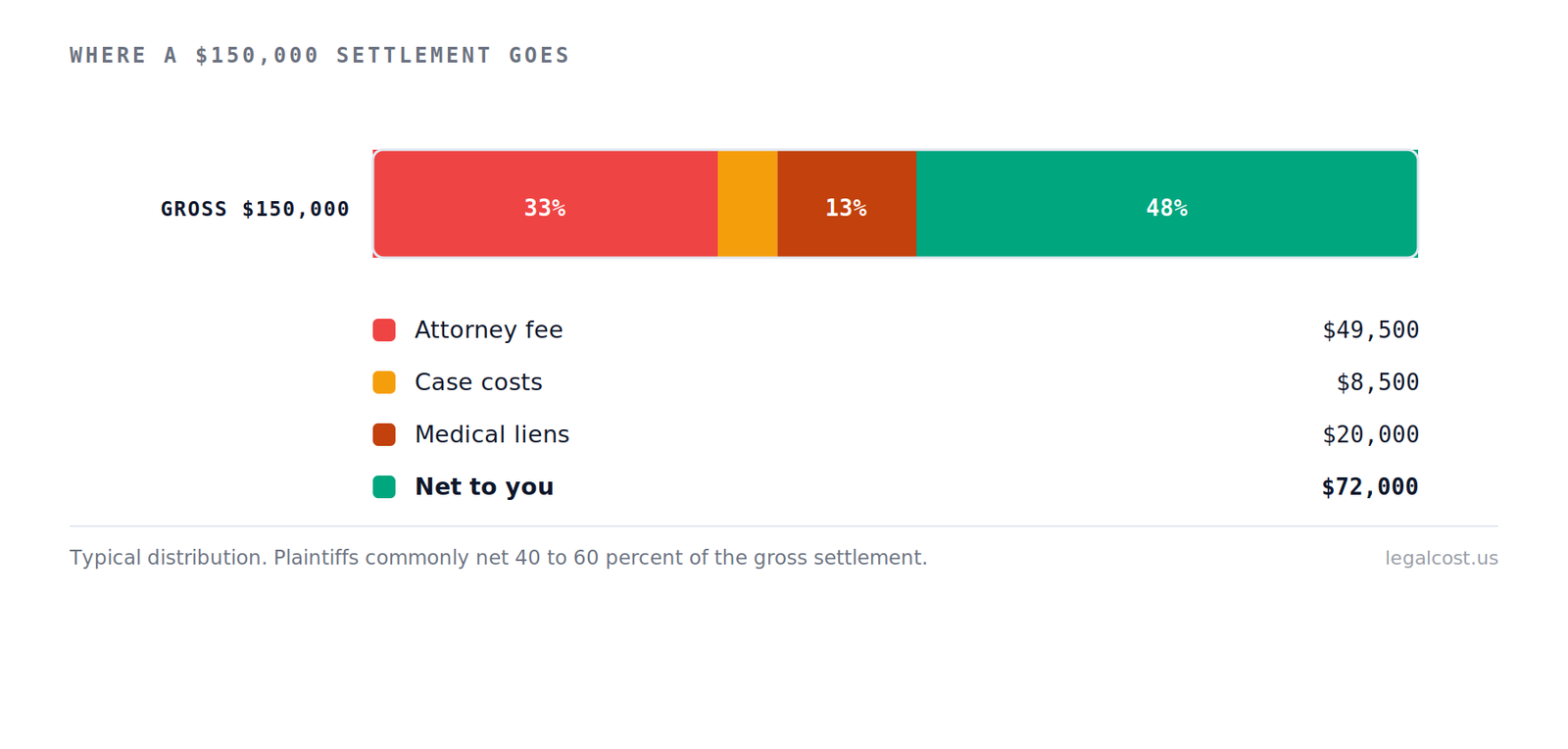
48 percent of the gross settlement. The attorney fee accounted for a third of the deductions; liens and expenses accounted for the rest.
That breakdown isn't a worst-case scenario. It's a Tuesday. After the fee, the costs, and the liens, most plaintiffs walk away with somewhere between 40 and 60 percent of the headline number. When a friend tells you their case "settled for $150,000," the check that actually hit their account was probably closer to $72,000.
Enter your settlement figure, fee percentage, costs and liens. See the net rather than the headline.
Open the Attorney Fee CalculatorCase Expenses Are Not the Fee
Clients confuse these two all the time, and plenty of lawyers don't go out of their way to clear it up. The fee is what the lawyer earns for their time and expertise. Case expenses are the hard costs of building the claim: the money that goes out the door to third parties.
Think court filing fees, police report requests, medical records copies, deposition transcripts, court reporters, expert witness retainers, accident reconstruction specialists, investigators, medical illustrations, and trial exhibits. Every one of those has a price tag.
Your firm typically fronts these and gets reimbursed from the settlement proceeds. In straightforward cases they might run $1,500 to $5,000. Once litigation starts and you need expert witnesses, the number jumps to $10,000 or $15,000 without much difficulty. As a percentage of the gross recovery, expect somewhere between 3 and 10 percent.
Read this clause carefully: What happens to those advanced costs if your case goes nowhere? Some firms eat the loss. Others expect you to pay them back regardless of outcome. Both positions are perfectly legal. Both show up in standard contracts. The difference only matters when a case fails, which is the worst possible moment to find out which version you signed.
Medical Liens, the Deduction Nobody Mentions
Here's the part that blindsides people. If someone else paid for your accident-related medical care, they're coming for their money once you settle. Insurance companies, Medicare, hospitals: they all have a legal claim on part of your recovery. Most clients don't hear about this until the settlement check is being divided up.
Medicare
Federal law requires reimbursement, full stop. The good news: Medicare doesn't just take its entire bill back. The lien is automatically reduced proportionally to reflect the attorney fees and costs that made the recovery possible. The formula typically cuts the original demand by roughly 25 to 40 percent, depending on the ratio of procurement costs to settlement size. Your lawyer handles the paperwork through the Medicare Secondary Payer Recovery Portal.
Medicaid
Also mandatory, but the details depend entirely on your state. Some states pursue these claims aggressively. Others leave more room to negotiate. The variance is wide enough that the same medical history can produce very different lien amounts depending on where you live.
Private health insurance
Your insurer asserts what's called contractual subrogation, a right written into your plan that lets them recover what they paid for your accident-related treatment. How much they can actually collect depends on the plan type (ERISA vs. state-regulated) and on your state's laws. In some states, that's nothing. In others, it's every dollar.
Provider liens
If a doctor or clinic treated you on a "letter of protection," agreeing to wait for payment until the case resolves, they hold a direct lien on the proceeds. Hospitals in many states can file their own statutory liens as well. These aren't optional; they have to be paid from the settlement.
Add it all up and these liens commonly consume 10 to 30 percent of the gross recovery. In serious injury cases with months of treatment, the lien total can actually exceed what the lawyer takes.
State Caps on Contingency Fees
In most states and most case types, the fee percentage is whatever you and your lawyer agree on. But legislatures have stepped in where they felt the market wasn't policing itself. About sixteen states regulate contingency fees in some form, and roughly two dozen cap fees in medical malpractice specifically. The usual mechanism is a sliding scale that shrinks the lawyer's share as the recovery gets larger.
| Jurisdiction | Applies to | Limit |
|---|---|---|
| California | Medical malpractice (MICRA) | 25% if settled before suit or arbitration demand is filed, 33% thereafter |
| New York | Medical malpractice (Jud. Law 474-a) | Sliding scale from 30% on the first $250,000 down to 10% above $1.25 million |
| New Jersey | All tort cases (Rule 1:21-7) | 33.33% on the first $750,000, 30% on the next $750,000, 25% on the next $750,000, 20% on the next $750,000, court approval above $3 million |
| Connecticut | All personal injury | Sliding scale beginning at 33.33% on the first $300,000, then 25%, then 20% |
| Florida | All personal injury (Bar Rule 4-1.5) | 33.33% before defendant answers, 40% after answer through trial (on first $1M), with declining scale above $1M |
| Federal | Social Security disability | 25% of past-due benefits or $9,200 (2026 cap), whichever is lower |
When a statutory cap applies, it overrides whatever your contract says. Your lawyer can't charge above the statutory limit. You can't waive it, even if you wanted to. The cap is the ceiling, period.
Sources: California Medical Injury Compensation Reform Act as amended by AB 35 (2022), effective Jan 1 2023; New York Judiciary Law 474-a; New Jersey Court Rule 1:21-7; Connecticut General Statutes 52-251c; Florida Bar Rule 4-1.5(f)(4)(B); 42 U.S.C. 406(a). Updated July 2026. Fee caps change; confirm current law in your state before relying on these figures.
What the Agreement Has to Contain
A contingency agreement isn't a handshake deal. It's a regulated document, and both the ABA and your state bar have specific opinions about what needs to be in it. Under ABA Model Rule 1.5, the agreement must be in writing, spell out the percentage, explain how expenses are handled, and describe what changes if the case settles versus going to trial.
Individual states pile on additional requirements. California's Business and Professions Code section 6147, for instance, requires the agreement to state the fee, explain how costs work, explicitly disclose that the fee is negotiable and not set by law, and lay out your right to fire your lawyer at any point.
And here's the backstop most people don't know about: every state imposes a reasonableness standard on attorney fees, separate from whatever the contract says. A signed agreement doesn't make a fee untouchable. If a court finds the fee unreasonable under the circumstances, it can be reduced after the fact.
For a minor injury you may not need a lawyer taking a third. A demand letter to the insurer is the usual first step. For serious injuries, compare fee agreements before you sign one.
Prepare your Demand Letter on LawDepotAffiliate link: LegalCost.us earns a commission from LawDepot at no extra cost to you.
What Happens If You Change Lawyers
This is one of the most common questions in contingency work and one of the least well explained. The fear is straightforward: if you leave one firm for another, do you end up paying two fees?
Almost never. You agreed to one percentage, and that percentage does not change because the case passed through two sets of hands. What changes is how that single fee is divided at the end.
You can change firms at any point
The right to choose your own representation survives a signed fee agreement. You do not need permission and you do not need to justify the decision. Persistent lack of communication, pressure to accept an offer you consider inadequate, or a simple loss of confidence are all sufficient reasons.
The former firm files an attorney lien
Also called a charging lien. It is a formal notice that the first firm expects to be paid from the eventual recovery for the work it already performed. It does not give them control of the case and it does not prevent you from moving. It sits against the settlement and is resolved before funds are distributed.
The split is decided by quantum meruit
The phrase means "as much as deserved". The first firm is entitled to the reasonable value of what it actually did, not to the full contingency fee it would have earned by seeing the case through. Courts weigh hours invested, the stage the case reached, and the contribution each firm made to the outcome. A firm that did no meaningful work is entitled to nothing.
The lawyers negotiate it between themselves
You are not the one arguing about the division. Your new firm handles the lien with the old one and satisfies it out of the same contingency fee you already agreed to. If the two disagree, the dispute is between them.
One point that reassures people once they hear it: if the case ultimately recovers nothing, neither firm is paid a fee. The contingency arrangement holds across the transition.
What Is Actually Negotiable
Most people treat the fee agreement like a take-it-or-leave-it contract. It's not. The printed form is a starting point, and firms with strong cases and busy dockets have more room to move than most clients realize. These four points are where the real money is.
If the liability is clear and the case looks like it will settle without a fight, ask for 25 to 28 percent on a pre-suit resolution. Plenty of firms will agree. A fast settlement at a slightly lower rate is better economics for them than a two-year slog at 40%.
This is the single highest-value change available in most agreements and the one almost nobody thinks to ask for. In a case where $20,000 or $30,000 in costs are expected, switching from gross to net puts more money in your pocket than shaving a full percentage point off the rate.
The standard jump to 40% triggers when a complaint is filed, not when you sit in a courtroom. Since the vast majority of filed cases still settle, your case can slide into the higher bracket and resolve by negotiation the following month. Ask for the higher percentage to kick in only if the case actually goes to trial.
This one doesn't reduce the fee, but it keeps costs from ballooning without your knowledge. Ask for a cap on total costs, or at minimum, a clause requiring your written approval before expenses exceed a set amount. It's a reasonable request that any transparent firm should be comfortable with.
None of these asks are unusual. None of them will offend a firm that's worth hiring. And a lawyer who flatly refuses to discuss fee structure has already told you something important about how the rest of the relationship is going to go.
Sources: ABA Model Rules of Professional Conduct Rule 1.5, California Business and Professions Code 6147, CMS Medicare Secondary Payer Recovery Portal guidance, published market rate surveys. Updated July 2026.
Frequently Asked Questions
What percentage do personal injury lawyers take?
The standard range across the United States is 33 to 40 percent of the gross recovery. Most agreements use a tiered structure that steps up as the case progresses: 33.33 percent if the case settles before a lawsuit is filed, 40 percent once suit is filed, and up to 45 percent if the case reaches trial or appeal. Some firms offer 25 to 28 percent for cases that resolve very early. Complex matters with multiple defendants occasionally reach 45 percent, though that must still satisfy the reasonableness standard under professional conduct rules.
Is the fee calculated before or after case costs?
It depends entirely on your written agreement, and the difference is significant. Under a gross basis the percentage applies to the full settlement before any expenses are reimbursed. Under a net basis expenses come out first and the percentage applies to the smaller remaining figure. On a $200,000 settlement with $20,000 in case expenses and a 33.33 percent fee, the gross basis produces a fee of $66,660 and the net basis produces $59,994. That is $6,666 more to the client for a single line in the contract. Most standard agreements use the gross basis.
How much do I actually take home from a settlement?
After the attorney fee, case expenses, and medical liens are paid, the net reaching the plaintiff commonly lands between 40 and 60 percent of the gross settlement. A worked example: a $150,000 settlement with a 33 percent fee of $49,500, case costs of $8,500, a negotiated Medicare lien of $12,000, and private insurer subrogation of $8,000 leaves $72,000, which is 48 percent of the gross. The percentage in your fee agreement is only one of four deductions.
What are case costs and who pays them?
Case costs are the external expenses required to build the claim, and they are separate from the attorney fee. They include court filing fees, police and medical records requests, deposition transcripts and court reporters, expert witness fees, investigators, and trial exhibits. The firm normally advances these and is reimbursed from the recovery. They typically run 3 to 10 percent of the gross settlement, commonly $1,500 to $15,000 or more in litigated cases. Ask specifically whether you owe advanced costs if the case produces no recovery.
What is a medical lien and how much does it take?
A medical lien is a legal claim held by whoever paid for your accident-related treatment. Medicare and Medicaid reimbursement is mandatory under federal and state law. Private health insurers assert contractual subrogation rights. Treating providers who agreed to be paid from the settlement hold their own liens. Together these commonly consume 10 to 30 percent of the gross recovery. Liens are negotiable, and Medicare routinely reduces its claim through a proportional formula that accounts for legal costs, often cutting the demand by 25 to 40 percent.
Which states cap contingency fees?
About sixteen states regulate contingency fees in some form, and roughly two dozen cap fees specifically in medical malpractice cases, usually through a sliding scale that drops the percentage as the recovery grows. New York Judiciary Law 474-a runs from 30 percent on the first $250,000 down to 10 percent on amounts above $1.25 million. New Jersey Court Rule 1:21-7 applies to all tort cases and starts at 33.33 percent on the first $750,000 with declining tiers above that. Connecticut caps fees in all personal injury cases, not only malpractice.
What is the fee cap for medical malpractice in California?
California caps attorney fees in medical malpractice cases under the Medical Injury Compensation Reform Act. Following the 2022 reform in Assembly Bill 35, effective 1 January 2023, fees are limited to 25 percent of the recovery if the case settles before a lawsuit or arbitration demand is filed, and 33 percent if it resolves after that point. This replaced the previous tiered percentage structure and applies to cases filed on or after 1 January 2023.
Are contingency fees negotiable?
Yes. The percentage is set by agreement, not by law, except where a statutory cap applies. The most effective points to negotiate are a reduced rate for cases that settle quickly before suit is filed, a net rather than gross calculation basis, a sliding scale that only rises to the higher tier if the case genuinely reaches trial rather than merely when a complaint is filed, and a ceiling on case expenses. Firms with strong cases and heavy caseloads have more room to move than the standard form suggests.
Do I pay anything if I lose?
You owe no attorney fee if there is no recovery, which is the defining feature of a contingency arrangement. Case expenses are a separate question and the answer varies by firm. Some absorb advanced costs when a case fails. Others require the client to repay them regardless of outcome. This provision is in the written agreement and it is the single most important clause to read before signing.
Do I pay two fees if I change lawyers?
Almost never. You agreed to one contingency percentage and that percentage does not increase because the case passed through two firms. The former firm files an attorney lien, also called a charging lien, and is paid the reasonable value of the work it actually performed under the doctrine of quantum meruit. The single fee is then divided between the two firms, and they negotiate the division between themselves rather than taking more from you. A firm that did no meaningful work is entitled to nothing, and if the case recovers nothing, neither firm is paid a fee.
Does the fee agreement have to be in writing?
Yes. American Bar Association Model Rule 1.5 requires contingency fee agreements to be in writing, to state the percentage clearly, to explain how expenses are deducted, and to describe what happens if the case settles versus goes to trial. States impose their own additional requirements. California Business and Professions Code section 6147 requires the agreement to state the fee percentage, explain how costs are handled, disclose that the fee is negotiable, and set out the client's right to terminate representation.
Fee, expenses and liens in one calculation. Free, no signup, results in under a minute.
Calculate My Net Recovery