
Most drivers just pay the fine. It looks small enough to be the cheaper option. It almost never is. The number printed on your citation is the smallest cost attached to it, and once you understand that, the question of whether it is worth an afternoon to contest it answers itself.
Disclaimer: This guide is for informational purposes only and is not legal advice. Traffic procedure, available remedies, and point systems vary by state and by court. Deadlines printed on your citation take precedence over anything described here. Consult a licensed attorney in your state if the stakes are significant.
Whatever you do, do not pay that ticket. Paying is the same as pleading guilty. Plead not guilty before the deadline on the citation, then send a written discovery request asking for the radar calibration records, the officer's field notes, and device certification. Your job is to challenge the evidence, not offer an excuse. A single conviction raises insurance premiums by 25 to 40 percent for the next two to three years, and that usually adds up to several times the fine itself. Run the numbers through our free Speeding Ticket Calculator to see what the ticket will really cost in your state.
The Fine Is the Smallest Part
Before anything else, look at the real numbers. They change the entire conversation about whether fighting is "worth the trouble."
A speeding conviction bumps your insurance premiums by roughly 25 to 40 percent, depending on the state and the insurer. That increase sticks around for two to three years. If you are paying $2,000 a year for coverage, expect an extra $500 to $800 annually, or somewhere between $1,500 and $2,400 over the life of the surcharge.
The fine printed on the citation? Usually under $200.
These are illustrative figures on a $2,000 annual premium, but the ratio holds no matter what you pay. What you can see on the ticket is a fraction of what you will actually spend.
There is a second cost that does not show up as money at all. Around 41 states operate a point system, and a speeding conviction adds points that stick on your record for two to five years. Points accumulate. If you are sitting two points away from a suspension threshold, you are not fighting over a fine anymore.
Paying Is Pleading Guilty
This is the single mistake that shuts down every option you have. And it happens constantly, because paying online takes ninety seconds and avoids a late fee.
A traffic citation is a legal charge. When you pay it, you are admitting guilt. The case closes. Points land on your record. The conviction shows up when your insurer checks at renewal. After that, there is no appeal and no way to undo it.
So if there is even a small chance you want to fight the ticket, do not pay. Not even provisionally, and not even when the deadline feels close. Entering a not guilty plea is what keeps every other option open.
Do not miss the plea deadline, either. That window is printed on the citation. It usually falls somewhere between 15 and 30 days. Miss it, and you could end up with a default conviction, extra penalties, and in some states a licence suspension for failure to appear. The plea deadline is a harder line than the hearing date itself.
Fine, court fees, points and the three-year insurance surcharge for your state, in one figure.
Open the Speeding Ticket CalculatorThe Sequence That Wins Cases
Contesting a ticket properly means treating it like a small piece of litigation. None of these steps are flashy. They are what separates walking out with a dismissal from walking out with a lecture and a fine.
Plead not guilty in writing, before the deadline
This is how you secure the right to a hearing. Most courts let you do it by mail or online. Some require you to show up for an arraignment. However it works in your jurisdiction, it has to happen inside the window printed on the citation.
File a discovery request immediately
This is the single highest-value move available to you, and almost nobody makes it. Send a certified letter to the prosecutor's office and the issuing law enforcement agency, requesting the evidence they plan to use.
Make sure you include the citation number, the date and location of the stop, and the officer's name. If three weeks pass with no response, file a motion to compel discovery with the court. A prosecution that cannot produce its own evidence has a much harder time making its case than one that shows up prepared.
Gather your own evidence while it still exists
Go photograph the location. Capture the speed limit signage, or the lack of it. Get sightlines, curves, and anything that might have blocked a clean radar reading. If you have dashcam footage or GPS data from your car's telematics, save it now. Most of those systems overwrite within days.
Write down the weather conditions, how heavy traffic was, and where the patrol vehicle was sitting. Do it while you actually remember, not weeks later when the details get fuzzy.
Look at the alternatives before you commit to trial
Most courts offer ways to avoid a conviction without going to a full hearing. But you typically have to ask before the court date, which is why this step comes now rather than at the last minute.
Argue the evidence, not your reasons
At the hearing, the burden sits with the prosecution. Your job is to show they have not met it. Not that you had somewhere important to be. That distinction decides most outcomes, and we cover it in detail below.
What Works and What Does Not
Traffic court judges hear the same stories every single day. "I was late." "Everyone else was going faster." Those are not defences. The arguments that actually produce dismissals go after the reliability of the evidence itself.
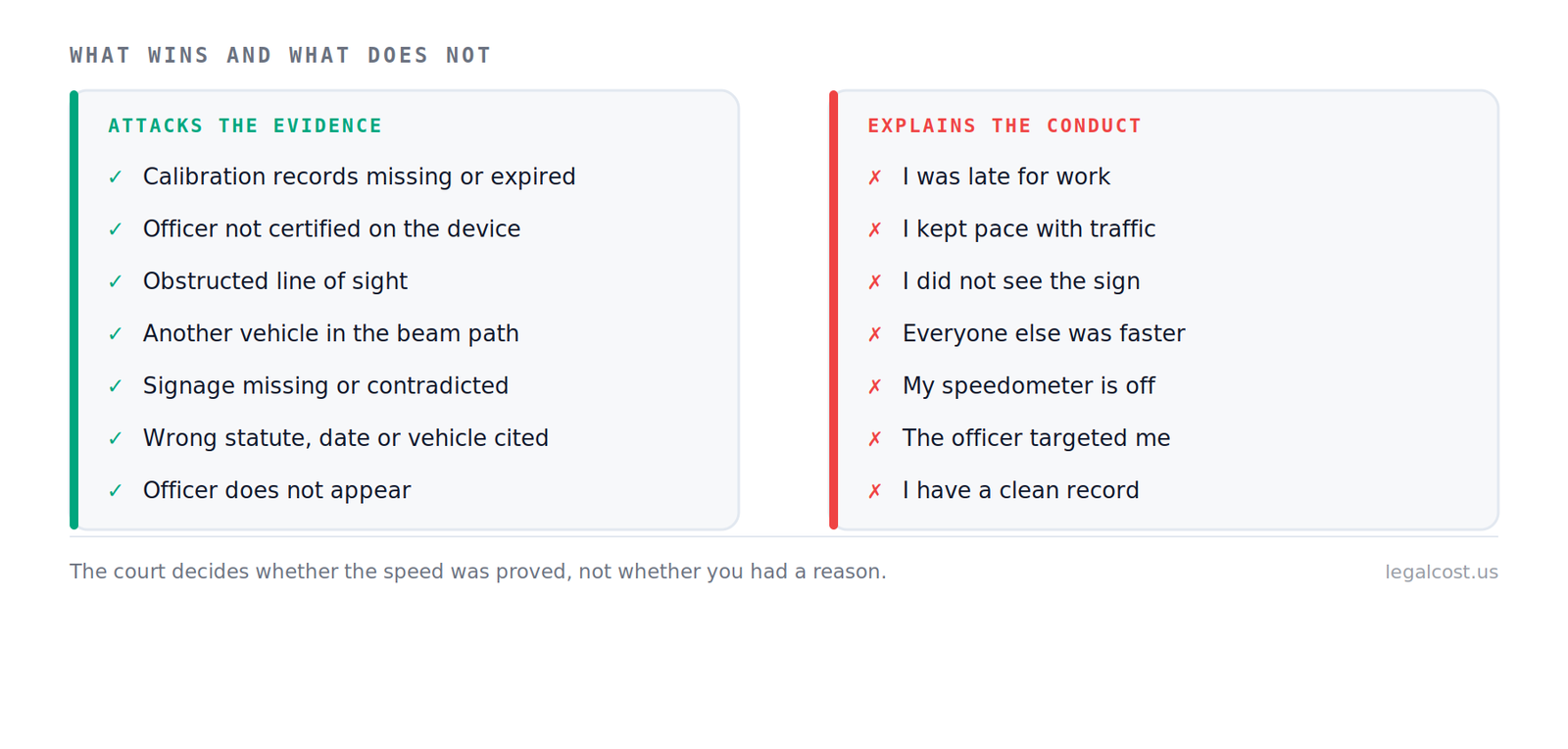
- Calibration records missing, expired, or showing a service flag
- Officer not certified on the device used
- Obstructed or insufficient line of sight for a lidar reading
- Another vehicle in the beam path at the moment of the reading
- Speed limit sign missing, obscured, or contradicted nearby
- Citation naming the wrong statute, wrong date, or a different vehicle
- Officer does not appear at the hearing
- I was late for work
- I was keeping pace with the traffic around me
- I did not see the sign
- Everyone else was going faster
- My speedometer must be wrong
- The officer targeted me unfairly
- I have a clean record otherwise
This is not about fairness. It is about what the court is actually deciding. The judge is asking one question: did the prosecution prove you exceeded the limit? Not whether you had a perfectly good reason to.
The officer no-show is real, and underrated. The officer is the prosecution's only witness in most speeding cases. Without that testimony, there is generally no admissible evidence of your speed, and the judge dismisses. Shift changes, leave days, and heavy caseloads mean no-shows happen more often than you would guess. Just scheduling a trial gives you a meaningful shot at a dismissal before you even open your mouth.
Sources: State traffic codes and rules of evidence, manufacturer calibration standards for radar and lidar speed measurement devices, published insurance rate impact analyses (CarInsurance.com, 2025). Updated July 2026. Procedure varies by court; confirm requirements with the clerk named on your citation.
The Routes That Avoid a Conviction
Winning at trial is one outcome. But several other paths get you to the same place without the risk, and they are often the smarter choice when the evidence against you looks solid.
Deferred disposition
Texas offers this widely, and other states have their own versions. You plead no contest, pay a fee, and then stay violation-free during a probation period that typically runs 90 to 180 days. Finish the probation cleanly and the citation is dismissed. No conviction gets reported for point purposes. The catch is that you usually need to request it before your court date, not at it.
Traffic school or a defensive driving course
Most states offer this option, though generally only once every 12 to 18 months (California's limit is 18 months from the violation date). You pay the fine plus a course fee, complete the course, and the points either never land on your record or get removed. One thing to ask about: in some states the conviction still shows on your record even after the course, so confirm whether it is actually hidden from insurers rather than just assuming it is.
Reduction to a non-moving violation
In many courts, prosecutors will negotiate a speeding charge down to an equipment offence or even a parking violation. The fine might end up being the same or higher. That is usually still the better deal by a wide margin, because a non-moving violation carries no points and does not get reported to your insurer the same way. When the insurance surcharge is the big number, paying a larger fine to avoid it is straightforward math.
Trial by written declaration
California offers this, along with a small number of other states. You contest the ticket entirely on paper. You submit a written statement and your evidence. The officer submits theirs. You deposit the bail amount when you file, and if you win, you get it back. If you lose, you can request a trial de novo (a fresh in-person hearing) within 20 days. It costs nothing beyond the deposit and a stamp, and it forces the officer to put the case in writing rather than just showing up.
Some courts accept a sworn written statement instead of a court appearance. Check your court’s rules first. With a commercial licence or a suspension at stake, talk to a traffic attorney.
Prepare your Affidavit on LawDepotAffiliate link: LegalCost.us earns a commission from LawDepot at no extra cost to you.
What to Expect in the Courtroom
Traffic court is informal compared to other courtrooms, but it still feels formal if you have never been. Knowing what the process looks like ahead of time takes away most of the anxiety.
Arrive early and dress as you would for a job interview
Not because your outfit is evidence. But credibility adds up in small ways, and you are asking a judge to take your word over a uniformed police officer's. Showing up looking serious about it helps.
The officer testifies first
They will describe where it happened, what the conditions were, how they identified your vehicle, and what the device read. Bring a notepad. Any inconsistency between what they say in court and what they wrote in their field notes is exactly what cross-examination is built for.
You may question the officer
Ask questions. Do not make speeches. "When was this device last calibrated?" "Where were you positioned relative to my car?" "How many other vehicles were in the area?" "Are you certified on this specific unit?" One question the officer cannot answer precisely does more for your case than five minutes of argument.
Then you present
Keep it short and stick to the facts. Point out what the evidence does not establish. Show your photographs. Highlight any gaps in the records you got through discovery. Whatever you do, do not start explaining why you were driving the way you were. That concedes the only fact in dispute.
The ruling usually comes immediately
Most traffic hearings are decided from the bench the same day. If you lose, ask about the appeal window and traffic school eligibility before you leave the building. Both are usually still available at that point, but nobody is going to remind you.
Camera Tickets Are a Different Animal
Everything above assumes an officer stopped you. If the citation arrived in the post from an automated camera, most of it does not apply, and the economics invert.
The reason is structural. A camera photographs a vehicle, not a driver. Because it cannot establish who was behind the wheel, most states attach liability to the registered owner rather than to a licence. That turns the violation into a civil matter closer to a parking ticket than to a moving violation.
| State | Points | Treatment |
|---|---|---|
| Arizona | None | Civil infraction against the registered owner |
| California | Varies | Depends on whether the city adopted the civil penalty framework |
| Florida | None | Civil infraction, does not appear on the driving record |
| Texas | None | Civil infraction against the owner |
| Illinois | None | Non-moving violation, barred from insurance underwriting |
| New York | None | Non-moving violation, barred from insurance underwriting |
| Virginia | None | Infraction, not reported to DMV as a moving violation, fine typically capped near $50 |
| Oregon | None | Treated similarly to a parking ticket; unpaid fines can block registration renewal |
Camera fines commonly run $50 to $150, with some jurisdictions above $300. Unlike a speeding ticket, the amount is usually flat rather than scaled to how far over the limit you were.
The exception that still matters
An officer-issued red light violation is an entirely different citation from a camera one, even for the same conduct. It attaches to your licence, typically adds 2 to 3 points, stays on the record for three to five years, and commonly raises premiums by 20 to 30 percent. If a human wrote the ticket, the rest of this guide applies in full.
The one you may not have to pay at all
California courts sometimes send what practitioners call a snitch ticket, issued when a camera captured the plate but not a clear image of the driver. It is headed with wording along the lines of "Courtesy Notice: This Is Not A Ticket." It is not an enforceable citation and it has not been filed with the court. Read any camera notice carefully before paying, because that heading is the difference between an obligation and a request.
Ignoring one is still a bad idea. The absence of points does not mean the absence of consequences. Unpaid camera fines commonly double, then go to collections. Several states block vehicle registration renewal. Illinois can suspend a licence after five unpaid citations. A civil penalty that escalates to a court judgment can end up on the record after all, which is the one route by which a camera ticket reaches your insurer.
Sources: State automated enforcement statutes, Illinois and New York insurance underwriting restrictions on non-moving violations, California Vehicle Code red light camera provisions, Insurance Information Institute. Updated July 2026. Camera enforcement rules are set locally as well as at state level; confirm with the issuing jurisdiction.
When a Lawyer Is Worth It
For a routine speeding citation, the system is built so you can handle it yourself. Hiring an attorney to contest a $180 ticket rarely makes economic sense on its own.
But there are four situations where it clearly does.
A commercial licence. If you hold a CDL, your livelihood rides on your driving record. The tolerances are tighter, employers check violations, and the calculation has nothing to do with the fine.
Proximity to a suspension. If the points from this ticket would push you past a threshold, you are not contesting a citation. You are contesting a suspension.
Excessive speed. Many states treat speeding far above the limit as reckless driving. That is a criminal charge, not a simple infraction, and the consequences are in a different category entirely.
Any accident or injury. Once there is a crash involved, the citation becomes evidence in a civil claim. Paying it and admitting fault can cost you far more than the ticket ever would.
Most traffic attorneys work on a flat fee. In many jurisdictions they can even appear on your behalf without you being there, which for anyone who cannot afford to take a day off work is often the deciding factor.
Sources: State traffic codes, Texas Transportation Code deferred disposition provisions, California Vehicle Code trial by written declaration procedure, state point system schedules. Updated July 2026.
Frequently Asked Questions
Is it worth fighting a speeding ticket?
In most cases, yes. The reason has little to do with the fine and everything to do with insurance. A speeding conviction typically raises your premiums by 25 to 40 percent, and that increase sticks for two to three years. On a $2,000 annual policy, you are looking at $1,500 or more in extra costs over that period. The fine itself is usually under $200. So the ticket is the cheapest part of the whole thing, and contesting even a small citation is often worth an afternoon of your time.
What happens if I just pay the ticket?
When you pay a traffic ticket, you are entering a guilty plea. The case closes immediately. Points go on your driving record (41 states use a point system), the conviction becomes visible to your insurer at renewal, and you lose any right to contest it after that. Paying online to dodge a late fee is the most common and most expensive mistake drivers make with a citation.
What is a discovery request and why does it matter?
It is a written demand for the evidence the prosecution plans to use against you. For a speeding ticket, that means the radar or lidar calibration logs, the officer's field notes, their training and certification records for the device, and any dashcam or bodycam video. Why does it matter? Because it is the step that wins cases, and hardly anyone bothers to take it. When the records come back incomplete, or the prosecution fails to hand them over at all, you can ask the court to throw out the speed reading or dismiss the case entirely.
How often do radar guns have to be calibrated?
It depends on the jurisdiction, but the standard is professional calibration every 30 to 60 days. On top of that, officers are supposed to run a tuning fork check at the start and end of each shift. If the calibration log has a gap, or the certificate has expired, or the device was flagged for maintenance, then the accuracy of the reading used against you is no longer an established fact. It becomes a genuine question the court has to consider.
What happens if the officer does not show up in court?
Usually, the case gets dismissed. The officer is the prosecution's witness, and without their testimony there is generally no admissible evidence of your speed. This happens more often than most people realize. Shift changes, scheduled leave, and heavy caseloads all contribute. It is one reason why simply requesting a trial gives you a real shot at a dismissal before you even make an argument.
What defences actually work against a speeding ticket?
Anything that goes after the evidence rather than trying to explain why you were speeding. That includes missing or expired radar calibration records, an officer who is not certified on the device they used, an obstructed line of sight for a lidar reading, or another vehicle sitting in the beam path. Speed limit signs that are missing, hidden, or contradicted by nearby signage also work. So does a citation that names the wrong statute, wrong date, or the wrong vehicle. What does not work: saying you were late, claiming everyone else was going faster, or that you did not see the sign.
What is trial by written declaration?
It is a procedure available in California and a handful of other states that lets you fight a ticket completely in writing. You never have to step foot in a courtroom. You submit your statement and evidence, the officer submits theirs, and a judge decides. You deposit the bail amount when you file, and if you win, you get it back. If you lose, you still have about 20 days to request a trial de novo, which is a completely fresh in-person hearing. Most states do not offer this and require you to appear.
What is deferred disposition?
Think of it as a probationary dismissal. Texas uses it widely, and other states have similar programs. You plead no contest, pay a fee, and stay violation-free during a probation period that usually runs 90 to 180 days. If you make it through cleanly, the citation is dismissed and nothing shows up as a conviction for point purposes. You typically have to request it before your court date. When the evidence against you is strong, this is often the smartest economic move.
Can I get the charge reduced instead of dismissed?
Yes, this happens more often than people think, and it is absolutely worth asking about. Prosecutors in many jurisdictions will agree to reduce a speeding charge to a non-moving violation like an equipment offence, or in some courts even a parking violation. The fine might be the same or even a bit higher, but here is the thing: a non-moving violation usually carries zero points and does not get reported to your insurer in the same way. Since the insurance surcharge is the real expense, paying a bigger fine to dodge it is usually the better deal.
Do red light and speed camera tickets add points?
In most states, no. Because a camera photographs a vehicle rather than a driver, liability attaches to the registered owner and the citation is treated as a civil infraction closer to a parking ticket than a moving violation. Arizona, Florida, Texas, Illinois, New York, Virginia and Oregon all issue camera citations without points. Illinois and New York go further and bar insurers from using them in underwriting. An officer-issued red light violation is entirely different: it attaches to your licence, typically adds 2 to 3 points, and commonly raises premiums by 20 to 30 percent. Unpaid camera fines can still escalate to collections, registration holds, or in some states a licence suspension.
Do I need a lawyer for a speeding ticket?
For a basic speeding citation, probably not. The system is set up so you can navigate it yourself. But an attorney starts making sense in a few specific situations: if you hold a commercial licence and your job depends on your driving record, if you are close to a suspension threshold on points, if the speed was high enough to trigger a reckless driving charge, or if the ticket is tied to an accident or injury. Traffic lawyers typically charge a flat fee, and in many jurisdictions they can show up for you so you do not have to miss work.
Fine, court fees, points and the insurance surcharge for your state. Free, no signup.
Calculate My Ticket Cost