
Most people who were fired unfairly have no case, and most of them do not find that out until months later, after the deadline has passed. The gap between an unfair firing and an unlawful one is narrower than it feels and wider than it looks. This guide covers exactly where the line sits, how little time you have, and what a claim is realistically worth.
Disclaimer: This guide is for informational purposes only and is not legal advice. Employment law varies by state and deadlines are strict and unforgiving. If you believe you were fired unlawfully, speak to a licensed employment attorney in your state as soon as possible rather than after reading further.
You can sue only if the firing was illegal, not merely unfair. Almost every state follows at-will employment, which allows an employer to fire you for a bad reason or no reason. A claim exists only if the termination was discrimination, retaliation, a violation of public policy, or a breach of contract. For federal discrimination claims the deadline is 180 days from the firing, or 300 days in states with their own agency, and it is strict. Median settlements run $30,000 to $50,000, with compensatory and punitive damages capped between $50,000 and $300,000 by employer size. Use our free Wrongful Termination Calculator to estimate your position.
Unfair Is Not the Same as Illegal
This single distinction decides more cases than any courtroom argument ever will, and most people only discover it after they have already missed their window.
Every US state except Montana operates under at-will employment. That means your employer can show you the door at any time, for any reason or no reason at all, without notice and without an explanation. Fired because a manager did not like your personality? Legal. Fired because someone in HR made a mistake? Also legal. Fired because the company wanted to bring in a cheaper replacement? Still legal. None of those situations, however unfair they feel, give you a case.
What at-will does not protect is firing someone for a reason the law has specifically declared off-limits. That is the entire test, and every section that follows flows from it.
The Four Categories
A firing crosses the line from unfair to illegal when it lands in one of the four buckets below. Outside of these, there is no catch-all fairness standard waiting in the wings.
Firing because of a protected characteristic: race, colour, religion, sex including pregnancy, national origin, age from 40, disability, or genetic information. Many states add marital status, sexual orientation, and gender identity.
Coverage thresholds apply. Title VII and the ADA reach employers with 15 or more employees. The ADEA reaches 20 or more.
Firing because you did something the law protects: reporting harassment or discrimination, filing a workers' compensation claim, raising a safety complaint, reporting fraud, or taking protected medical leave.
Retaliation claims are frequently stronger than the underlying complaint, because timing is easier to prove than motive.
Firing for refusing to break the law, for serving on a jury, for voting, or for military service. The scope of this exception varies enormously between states.
Texas recognises a particularly narrow version under the Sabine Pilot doctrine: refusing to perform an act that would expose you to criminal liability.
Firing in violation of a written employment agreement, a collective bargaining agreement, or in some states an implied contract created by employee handbook language or repeated assurances.
If you have a written contract with a for-cause termination clause, you are not at-will, and the analysis is entirely different.
Two things worth knowing about how these play out in real life. First, they stack. A single firing can support a discrimination claim under federal law, a parallel claim under a state statute that offers better remedies, and a contract claim, all running at the same time. Which combination your attorney chooses to plead can matter more than the underlying facts, because it shapes what damages are on the table.
Second, the retaliation bucket catches far more cases than most people realise. You do not need to have been right about the complaint you filed. In most jurisdictions, raising a concern in good faith is enough. So if you reported harassment that ultimately turned out to be unfounded, you are still protected from being fired for having reported it in the first place.
The Deadline That Ends Most Claims
If there is one section of this guide to read carefully, this is the one. More valid wrongful termination claims die from missed deadlines than from weak facts.
State deadlines are a separate clock entirely, and they vary a lot. California gives you three years under the Fair Employment and Housing Act, which is among the most generous windows in the country. Florida gives you 365 days to file with the Florida Commission on Human Relations. Texas holds to 180 days through the Texas Workforce Commission. And if your case involves workers' compensation retaliation, the timeline shifts again: four years in Florida, two in Texas.
Why this catches people: After a firing, the instinct is to find another job first and think about legal options later. By the time the job search stalls and you start seeing a pattern in what happened, four or five months have often gone by. Here is the thing: filing an EEOC charge is free, you can do it online, and it does not commit you to anything. If there is even a chance you have a claim, filing early costs you nothing and keeps every option open.
Salary, time out of work, employer size and claim type in one calculation.
Open the Wrongful Termination CalculatorWhat Actually Happens After You File
A lot of people assume they can go straight to court. For federal discrimination claims, you cannot. You have to go through the administrative process first, and if you skip it, the judge will throw your case out no matter how strong the evidence is.
It is free, and you do not need a lawyer to do it. You can file online, by mail, or walk into a local EEOC office. The charge itself is straightforward: who you are, who the employer is, what happened, and why you believe it broke the law.
This is where things slow down. Six months to two years is normal for the investigation phase. The agency might request documents from the employer, interview witnesses, or offer mediation. If you can get into early mediation, things move considerably faster than if you sit through the full investigation.
The EEOC sends this once it wraps up, regardless of whether it found cause or not. And here is a detail people often miss: a "no cause" finding does not stop you from suing. It changes your leverage at the negotiating table, but it does not take away the right. From the date on that letter, you have exactly 90 days to get into federal court.
The vast majority of these cases never see a courtroom. They settle. The typical timeline from filing the lawsuit to reaching a resolution is roughly 12 to 18 months, though complex disputes can drag on for three years. When you add the administrative phase on top of that, the full journey from the day you were fired to a cheque in your hand is frequently over two years.
What You Can Recover
Not all damages are created equal, and understanding the categories explains why two cases that look similar on paper can end up with wildly different payouts.
This covers every dollar in wages and benefits you lost between the day you were fired and the day the case resolves. It is driven entirely by your salary and how long you were out of work. For many claimants, this is the single largest piece of the recovery, and crucially, it has no federal cap.
This compensates for future losses when going back to the old job is not realistic. Courts look at how long it will take you to land comparable pay elsewhere. Older workers and people whose professional reputation took a hit tend to receive longer front pay awards.
Emotional distress, reputational harm, and other losses that resist precise measurement. Real, but harder to prove and subject to the federal ceiling.
These only come into play when the employer acted with malice or showed reckless indifference to your rights. A manager who made a bad call does not trigger punitive damages. Courts want to see intentional misconduct, a pattern that hit multiple employees, or attempts to destroy evidence.
Here is a detail that changes the math. Under Title VII, the ADA, and the ADEA, a winning employee can have their attorney fees paid by the employer rather than deducted from the settlement. That changes the economics of hiring a lawyer significantly, and it is one reason contingency arrangements are so common in employment cases.
The Cap Nobody Expects
This is the part that blindsides people, and it is worth understanding before you start putting a number on your case.
Under Title VII and the ADA, compensatory and punitive damages are capped together on a sliding scale that depends on how many people the employer has on payroll. Not each category separately. The combined total.
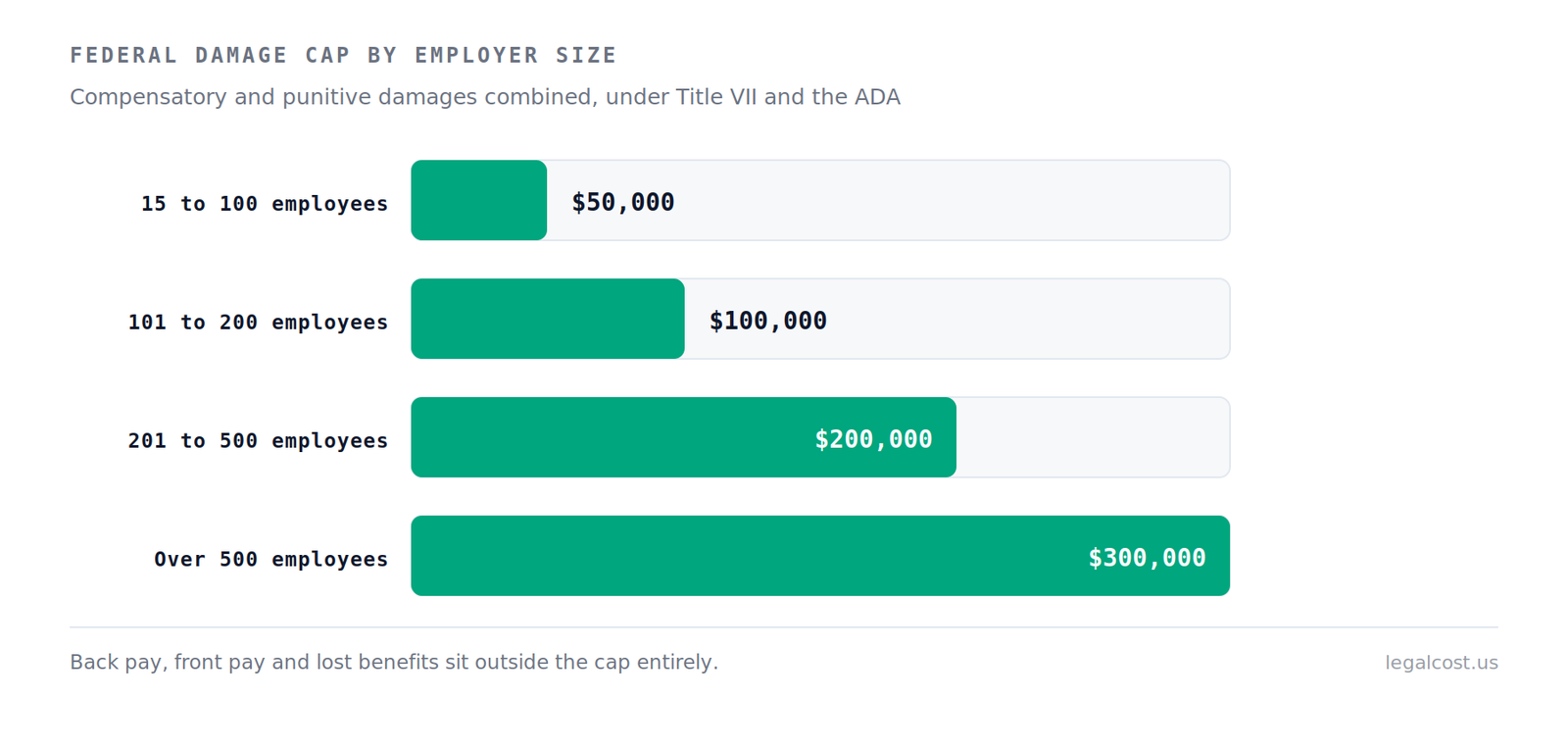
Federal cap on compensatory and punitive damages combined, under Title VII and the ADA. Back pay, front pay and lost benefits sit outside the cap entirely.
The practical consequence is hard to swallow. A 40-person company that behaved appallingly faces a $50,000 ceiling on emotional distress and punishment combined, regardless of how bad the conduct was. The exact same misconduct at a company with 600 employees hits a $300,000 ceiling. The size of the employer matters more than the severity of what they did.
This is also why your salary and time out of work drive the value of a case more than the employer's behaviour. Someone earning $120,000 a year who spent eighteen months unemployed has a substantial uncapped back pay claim. Someone earning $40,000 who found comparable work in six weeks does not, even if the employer's conduct was identical.
Sources: Title VII of the Civil Rights Act of 1964 (42 U.S.C. 2000e), Civil Rights Act of 1991 damage caps, Americans with Disabilities Act, Age Discrimination in Employment Act, EEOC enforcement and litigation statistics. Updated September 2026. Deadlines and caps are jurisdiction-specific; confirm with an attorney in your state.
What Cases Actually Settle For
The numbers you see in the news and the numbers most people actually receive are not even in the same neighbourhood, so it pays to look at this carefully.
EEOC data puts the median settlement for individual discrimination charges somewhere in the $30,000 to $50,000 range. Cases that make it all the way to a jury tend to produce much higher numbers, with verdicts frequently clearing $250,000, though a good portion of those get reduced on appeal or brought back down by the statutory cap.
Both of those figures are before attorney fees (typically 25 to 40 percent on contingency) and before taxes come off.
High salary, a long stretch of unemployment, documentary evidence in the employer's own words (emails are gold), a pattern that affected multiple employees, a large employer size, and filing under a state statute that does not cap damages.
Finding a new job quickly at similar pay (great for you, but it shrinks the back pay claim), a documented history of performance issues the employer can wave around, a small employer with a low cap, weak evidence of discriminatory motive, and any unexplained delay in filing that makes the timeline look suspect.
On duty to mitigate: Courts expect you to look for comparable work after a firing, and your back pay award gets reduced by whatever you earned or could reasonably have earned in the meantime. That does not mean you have to accept the first offer at any salary. It does mean you need to keep a log of every application you send out, because the employer's lawyers will argue you sat on your hands and the burden of proving a real job search falls squarely on you.
Tax Treatment
Nobody thinks about taxes when they are fighting to get compensated for a wrongful firing, but the IRS is going to take its share, and the structure of the settlement can make a meaningful difference in what you actually keep.
Back pay and front pay are taxed as ordinary income because they stand in for wages, and yes, payroll taxes apply too. Punitive damages are fully taxable. Compensatory damages for emotional distress are also taxable unless the distress came from a physical injury or physical sickness, which almost never applies in employment cases.
There is a second issue that catches people off guard. A settlement that covers two years of lost wages usually arrives as one lump sum in a single tax year. That can push you into a bracket well above what those wages would have triggered if you had earned them normally. It is worth running the numbers on the after-tax figure before you agree to a settlement amount, and in some cases the way the payment is structured is itself negotiable.
A formal demand letter puts your claim on the record and asks for a response by a set date. Deadlines in this area are short, so speak with an employment attorney early.
Prepare your Demand Letter on LawDepotAffiliate link: LegalCost.us earns a commission from LawDepot at no extra cost to you.
What to Do in the First Week
Most of the evidence that makes or breaks a wrongful termination case is either secured or lost for good in the first few days after the firing. Here is what matters.
Who was in the room, what exactly was said, the stated reason for the termination, and anything said in the weeks before it that now looks suspicious. Memory fades faster than you think, and a note written on the day of the firing carries far more weight in court than a recollection pieced together months later.
Performance reviews, awards, emails, text messages, your employment agreement, and the employee handbook. Company email and shared drives are usually shut off the same day you are walked out. If you do not already have personal copies of these documents, the window to get them is extremely narrow.
If at all possible, ask for the reason for your termination in writing. Why? Because employers who later change their story create one of the strongest evidentiary patterns a plaintiff can have. A documented first version is what makes that shift visible to a judge or jury.
Severance packages almost always come with a release of claims tucked inside. If you are 40 or older, the Older Workers Benefit Protection Act gives you at least 21 days to review the agreement and another 7 days to change your mind after signing. Do not rush. Signing away your rights in exchange for a few weeks of pay can cost you a claim worth many times the severance offer.
Both because you need income and because a documented search protects your back pay claim down the road. When the employer's lawyer argues you failed to mitigate, that application log is your defence.
Sources: Equal Employment Opportunity Commission filing guidance and enforcement data, Older Workers Benefit Protection Act, Internal Revenue Code section 104, state fair employment agency deadlines. Updated September 2026.
Frequently Asked Questions
Can I sue my employer for firing me unfairly?
In most situations, no. That answer surprises a lot of people, but at-will employment means your boss can fire you for a bad reason, a petty reason, or no reason whatsoever. The law only steps in when the firing crosses into one of four specific categories: discrimination on a protected characteristic (race, sex, age, disability, and others), retaliation for doing something legally protected, a violation of public policy, or a breach of your employment contract. "Unfair" and "illegal" are two very different standards, and that gap is where most claims fall apart before they start.
What counts as wrongful termination?
It boils down to four buckets. Discrimination means you were fired because of who you are: your race, religion, sex (including pregnancy), age (40 and up), disability, national origin, or genetic information. Retaliation means the company let you go for doing something the law protects, like reporting harassment, filing a workers' comp claim, or flagging a safety issue. Public policy covers situations where you were fired for refusing to break the law, serving on a jury, voting, or fulfilling military duty. And contract-based claims come up when there is a written agreement, a union contract, or sometimes even a handbook that created an implied promise about job security. If your situation does not fit one of those four, it probably is not actionable no matter how unfair it feels.
How long do I have to file a wrongful termination claim?
For federal discrimination claims, you get 180 days from the day you were fired to file a charge with the EEOC. If your state runs its own fair employment agency (most do), that window stretches to 300 days. Important: the clock starts on the day it happened, not the day you figured out it might have been illegal. After the EEOC wraps up its process, you get a right-to-sue letter and then exactly 90 days to file in federal court. State deadlines are all over the map. California gives you three years under FEHA, Florida gives you 365 days through its state commission, and Texas only allows 180 days with the Texas Workforce Commission. Missing any of these deadlines kills your claim, full stop.
Do I have to file with the EEOC before suing?
If your claim falls under the big federal statutes (Title VII, the ADA, or the ADEA), then yes, you have to go through the EEOC first. Skip that step and a judge will toss your case no matter how strong it is. But not every type of wrongful termination claim requires it. Breach of contract claims and some public policy claims can go straight to court. The same is true for certain state law claims, depending on where you live. Figuring out which route applies is one of the first things an employment attorney will sort out for you, and getting it wrong can be expensive.
How much is a wrongful termination case worth?
Based on EEOC data, the median settlement for individual discrimination charges lands somewhere between $30,000 and $50,000. Cases that actually reach a jury tend to come in a lot higher, with verdicts regularly topping $250,000, though appeals often knock those numbers down. Keep in mind those figures come before your attorney takes their cut, which is usually 25 to 40 percent under a contingency arrangement. What really drives the value of your specific case is not how badly your employer acted. It is your salary, how long you were out of work, and how strong your documentation is. A well-documented claim from a high earner can be worth many times the median.
What damages can I recover?
Several types. Back pay makes up the income and benefits you lost between the firing and the resolution. Front pay covers future earnings when getting your old job back is not realistic. Compensatory damages address emotional distress and reputational harm. Punitive damages come into play when the employer acted with malice or reckless indifference. One piece of good news: under Title VII, the ADA, and the ADEA, attorney fees can be recovered from the employer, so in some cases you do not end up paying them out of your own pocket. Also worth knowing: back pay and front pay are not subject to the federal damage caps, so those two categories have no ceiling.
Are wrongful termination damages capped?
Under federal law, yes. Title VII and the ADA cap compensatory and punitive damages together on a scale that depends on how many people your employer has on payroll: $50,000 if they have 15 to 100 employees, scaling up to $300,000 for companies with more than 500. That cap covers both categories combined, not each one separately. The silver lining is that back pay, front pay, and lost benefits sit outside the cap entirely, so those amounts have no limit. There are also ways around the cap. Section 1981 race discrimination claims carry no cap at all, and some state laws, including New York's State and City Human Rights Laws, have no ceiling either. That is why picking the right statute to file under matters so much.
How long does a wrongful termination case take?
Longer than most people expect. The EEOC investigation phase alone typically takes six months to two years before they hand you a right-to-sue letter. If you end up filing a lawsuit after that, most cases settle rather than going to trial, usually within 12 to 18 months of filing. Complicated cases can stretch to three years. There is a faster track: if both sides agree to EEOC mediation early on, the timeline shrinks considerably. But realistically, from the day you are fired to the day you see a settlement cheque, you are looking at two years or more in most cases.
Do I need a lawyer for a wrongful termination claim?
Technically, no. You can file an EEOC charge on your own, and it costs nothing. But once things move past the initial charge, an attorney starts earning their keep fast. Which statutes you file under determines what damages you can recover and whether a cap applies, and that kind of strategic choice is hard to get right without experience. The good news is that most employment lawyers work on contingency (25 to 40 percent of what you recover), so you do not pay upfront. Many also offer free case evaluations. And since attorney fees are recoverable from the employer under the major federal statutes, the math often works out better than you would think at first glance.
Is a wrongful termination settlement taxable?
Most of it, yes, and this catches a lot of people off guard. Back pay and front pay count as ordinary income because they replace the wages you would have earned, so the IRS taxes them just like a paycheck, payroll taxes included. Punitive damages are taxable too. Compensatory damages for emotional distress are also taxable, with one exception: if the distress arose from a physical injury or physical sickness, that portion is excluded under IRC section 104. The other trap is the lump-sum problem. A settlement that covers two or three years of lost wages all landing in a single tax year can push you into a much higher bracket than you would have been in earning that same money over time. It is worth running the numbers with a tax professional before you agree to a final figure.
Back pay, front pay and the applicable federal cap for your employer size, in one estimate.
Calculate My Claim