
Search for the average alimony payment and you will find plenty of confident numbers. Most of them are made up. No government database publishes average alimony amounts by state. The reason that matters: alimony is not calculated from a national benchmark. It comes from a formula that exists in only six states and from judicial discretion everywhere else. This guide breaks down what your state actually does, with the real formulas and the real caps.
Disclaimer: This guide is for informational purposes only and is not legal advice. Alimony law varies by state and changes regularly. Courts retain discretion to deviate from any formula. Figures cited are statutory rules and published study results, not predictions about your case. Consult a licensed family law attorney in your state.
There is no official average alimony payment in any US government database. What exists is your state's formula. When one hypothetical couple was run through every state guideline, the results ranged from nothing at all in Texas, Virginia, and New Mexico to $1,381 per month in Louisiana, with Florida second at $724. Only six states use a formula: California, Colorado, Illinois, Massachusetts, New York, and Pennsylvania. Everywhere else a judge decides. Use our free Alimony Calculator for your state.
Why There Is No Official Average
Start here, because this one fact explains why every figure you find online contradicts the last one you read.
The IRS does not publish state-level alimony data. The Census Bureau collects alimony received through its Survey of Income and Program Participation, but only as a single national number, with no breakdown by state. There is no federal register of support orders. Courts are not required to report what they award in any aggregated way.
So when you see an article claiming the average alimony payment in Ohio is some precise dollar figure, that number did not come from actual measurement. It is almost always a formula output, a poll of attorneys, or a rough estimate dressed up with more certainty than the data behind it deserves.
What the Formulas Actually Produce
The closest thing to an apples-to-apples comparison comes from a Custody X Change study that ran one hypothetical couple through every state guideline that produces a number. Same incomes, same marriage length, same custody split. The only variable was the state.
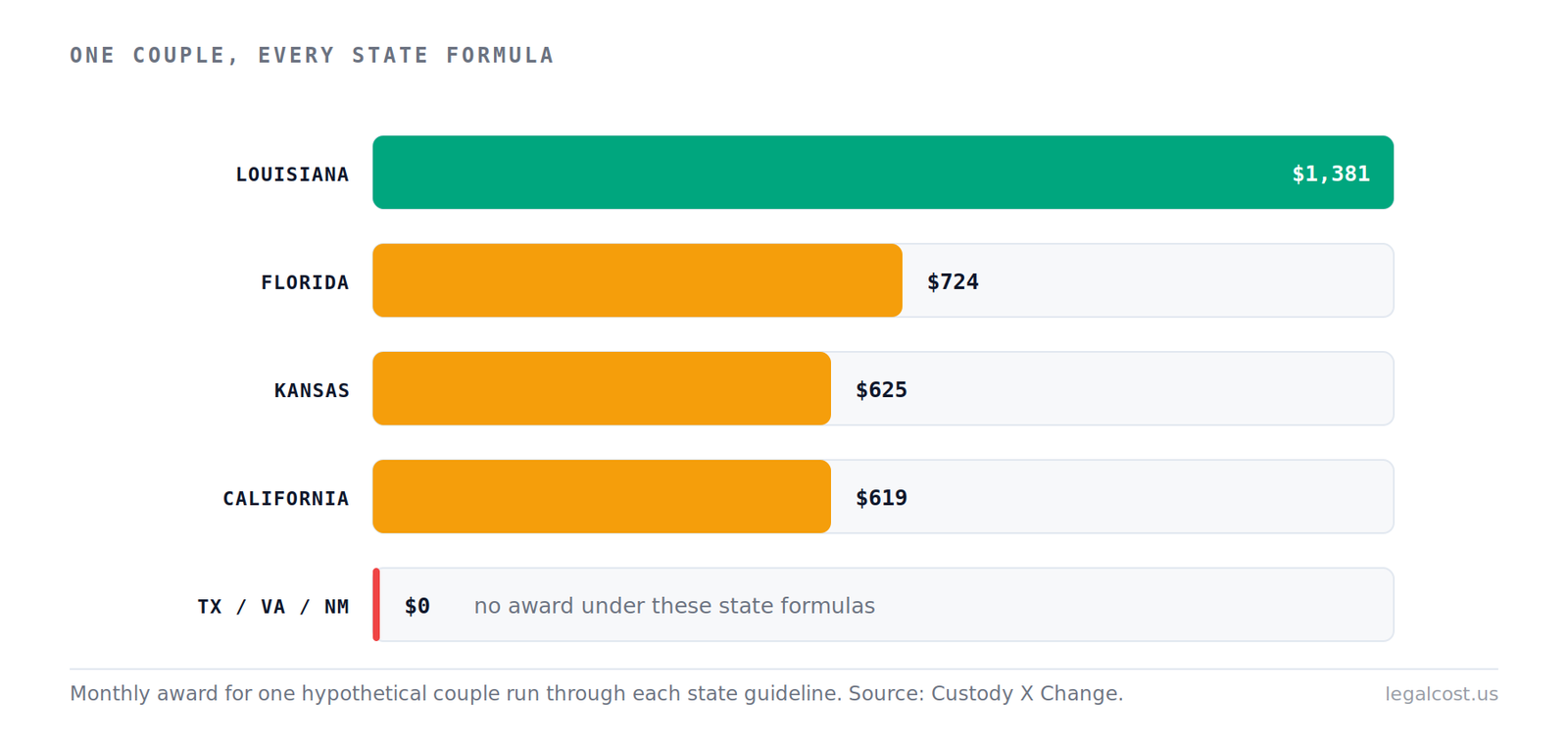
Monthly award for one hypothetical couple run through each state guideline. Only thirteen states produced a number at all: the six formula states plus states whose caps, local guidelines or case law let the study estimate one. Source: Custody X Change state alimony study.
Louisiana came out highest by a wide margin. The reason is straightforward: its formula was the only one that ignored the recipient's income entirely. Every other state subtracts something for what the lower earner already makes, which pulls the number down.
Three states produced nothing at all. That is not a rounding artifact. In Texas the couple simply did not meet the eligibility threshold. In Virginia and New Mexico the formula netted out to zero on those particular facts.
The spread between Louisiana's $1,381 and Texas's $0 is the whole point of this comparison. Same couple, same jobs, same years married. The only thing that changed was which side of a state line they lived on.
The Six Formula States
Six states give you an actual number to work with: California, Colorado, Illinois, Massachusetts, New York, and Pennsylvania. Each publishes a guideline formula that serves as the starting point. Courts can deviate, but the formula anchors the negotiation and gives both sides something concrete to argue around.
California
FormulaThe most widely cited guideline in the country, and the one other states often borrow from informally. One thing to know: this formula applies to temporary support during the divorce. For long-term support after the decree, California judges weigh fourteen discretionary factors under Family Code 4320, with no formula at all.
- Temporary formula
- 40% of higher earner's net income minus 50% of lower earner's net income
- Worked example
- $10,000 and $3,000 monthly: (40% x 10,000) minus (50% x 3,000) equals $2,500 per month
- Long-term support
- No formula. Courts evaluate need, ability to pay, marital standard of living, career sacrifice, and ten other statutory factors
- Duration
- Roughly half the marriage length under ten years. For marriages of ten years or more, the court retains jurisdiction indefinitely rather than setting an end date
New York
Formula, presumptive amountNew York runs two calculations and applies whichever produces the lower number. The percentages shift depending on whether child support is also being paid, a detail many guides leave out. Since the 2016 reform the court must award the formula amount unless it finds that result unjust; only the duration schedule is advisory.
- Without child support
- Formula A: 30% of payor's income minus 20% of recipient's income. Formula B: 40% of combined income minus recipient's income. The lesser applies.
- With child support
- Formula A: 20% of payor's income minus 25% of recipient's income. Formula B: 40% of combined income minus recipient's income. The lesser applies.
- Income cap
- Payor income above $241,000 is excluded from the formula and left to judicial discretion (updated March 2026)
Illinois
FormulaIllinois works from net income rather than gross, and applies a hard ceiling on what the recipient can end up with.
- Formula
- 33.33% of payor's net income minus 25% of recipient's net income
- Ceiling
- Recipient's combined income cannot exceed 40% of the couple's combined net
- Duration
- A multiplier applied to marriage length, running from 20% for short marriages up to 100% for marriages over twenty years
Massachusetts
Formula plus duration capsMassachusetts is unusual in that it constrains both the amount and the duration by statute, which makes outcomes more predictable than almost anywhere else.
- Amount
- Generally 30% to 35% of the difference in gross incomes
- 5 years or less
- Duration capped at 50% of the marriage length
- 5 to 10 years
- Duration capped at 60% of the marriage length
- 10 to 15 years
- Duration capped at 70% of the marriage length
- 15 to 20 years
- Duration capped at 80% of the marriage length
- Over 20 years
- Indefinite, until payor reaches full Social Security retirement age
Colorado
Advisory guidelineColorado publishes an advisory formula under C.R.S. 14-10-114. Courts use it as a starting point but can deviate after weighing the statutory factors.
- Formula
- 40% of the couple's combined monthly income minus the lower earner's monthly income, multiplied by 80% or 75% depending on combined income
- Multiplier
- 80% when combined monthly income is $10,000 or less. 75% when it exceeds $10,000
- Income cap
- Formula applies only when combined annual gross income is $240,000 or less. Above that, full judicial discretion
- Duration
- Scales with marriage length. A ten-year marriage suggests roughly 54 months. Over twenty years, indefinite maintenance is possible
Pennsylvania
Formula for temporary onlyPennsylvania is a formula state with an important catch: the formula covers only temporary support during the divorce process. Post-divorce alimony has no formula at all and relies entirely on seventeen statutory factors under 23 Pa.C.S. 3701.
- Temporary, no children
- 33% of payor's net income minus 40% of recipient's net income
- Temporary, with children
- 25% of payor's net income minus 30% of recipient's net income
- Post-divorce
- No formula. Courts weigh income, marriage length, standard of living, age, health, and earning capacity
- Duration
- No statutory cap. Terminates on remarriage or death. Can be modified on substantial change in circumstances
Our calculator applies the guideline for your state rather than a national average that does not exist.
Open the Alimony CalculatorThe Hard-Cap States
Two states go further than a guideline. They impose hard ceilings that override everything else, and in one of them, the first question is not how much you will pay but whether you qualify at all.
Texas
Restrictive, hard capThe most restrictive regime in the country. In Texas the first question is not how much, it is whether you qualify at all.
- Eligibility
- Marriage of at least ten years and inability to meet minimum reasonable needs, or family violence within the preceding two years
- Amount cap
- The lesser of 20% of the payor's average monthly gross income or $5,000 per month
- Duration
- 5 years for marriages of 10 to 20 years, 7 years for 20 to 30 years, 10 years for marriages over 30 years
This is why Texas produced a zero in the comparison study. The hypothetical couple did not clear the eligibility gate, so no amount was ever calculated.
Florida
Reformed 2023Florida abolished permanent alimony in its 2023 reform. Four types survive under Florida Statute 61.08, each with its own limit.
- Temporary
- During the proceedings only
- Bridge-the-gap
- Maximum two years, and it cannot be modified once ordered
- Rehabilitative
- Requires a specific written plan, capped at five years
- Durational
- Limited to 50% of the marriage length for marriages under 10 years, 60% for 10 to 20 years, and 75% for 20 years or more
Everywhere Else: Judicial Discretion
In roughly two thirds of the country there is no formula. A judge reads through a statutory list of factors and picks a number.
The factors themselves are similar everywhere: how long the marriage lasted, how much each spouse earns or could earn, the standard of living the couple maintained, the age and health of both parties, whether one spouse gave up a career for the other, and how long the lower earner needs to get back on their feet.
What changes from courtroom to courtroom is how much weight each factor gets. Two judges in the same building, looking at the same facts, can land on meaningfully different numbers, and both decisions can stand on appeal. That is not a bug in the system. It is how discretion works.
A handful of these states still permit genuinely indefinite awards. Connecticut, New Jersey, North Carolina, Oregon, Vermont, and West Virginia continue to allow open-ended maintenance, particularly after long marriages with a substantial earning gap. Most states have dropped the word "permanent" since the reform wave that started around 2014, but dropping the label is not the same thing as eliminating the outcome.
What this means in practice: In a formula state both sides can calculate the same number and negotiate around it. In a discretion state you are negotiating around a range, and how well you document your case matters more than the math. Detailed records of spending habits, career sacrifices, and actual household expenses carry real weight when there is no formula to anchor the conversation.
The AAML Benchmark
When a state offers no formula, family law attorneys often fall back on the benchmark published by the American Academy of Matrimonial Lawyers. It has no legal authority anywhere, but it shows up in settlement discussions often enough that you should know what it says.
For duration, the AAML benchmark uses a sliding scale: 0.3 times the marriage length for marriages under three years, 0.5 for three to ten years, and 0.75 for ten to twenty years. Above twenty years, the benchmark suggests permanent support. So a fifteen-year marriage lands at about 11.25 years under the AAML model.
Use it as a reference point, not an answer. If your state has its own formula, that formula governs. In a discretion state, the AAML figure gives you a number to put on the table, but it is not a prediction of what a judge will do.
Sources: Custody X Change state alimony study, American Academy of Matrimonial Lawyers published guidelines, state statutory formulas including Texas Family Code Chapter 8 and Florida Statute 61.08. Updated September 2026. Alimony rules change frequently; confirm current law in your state before relying on these figures.
How Long Alimony Lasts
Duration is calculated separately from amount, and it almost always tracks how long the marriage lasted rather than how much anyone earns. This is where most people get their estimate wrong. A modest monthly payment stretched over many years adds up to more than a large payment that ends quickly.
| State | Marriage length | Duration limit |
|---|---|---|
| Massachusetts | 5 years or less | 50% of the marriage length |
| Massachusetts | 5 to 10 years | 60% of the marriage length |
| Massachusetts | 10 to 15 years | 70% of the marriage length |
| Massachusetts | 15 to 20 years | 80% of the marriage length |
| Texas | 10 to 20 years | 5 years |
| Texas | 20 to 30 years | 7 years |
| Texas | Over 30 years | 10 years |
| Illinois | Under 5 years | 20% of the marriage length |
| Illinois | Over 20 years | Up to 100% of the marriage length, or indefinite |
| Florida | Bridge-the-gap | 2 years maximum, non-modifiable |
| Florida | Rehabilitative | 5 years maximum, written plan required |
| California | Under 10 years | Roughly half the marriage length |
| California | 10 years or more | No fixed end date, court retains jurisdiction |
Arizona set the shortest minimum in the Custody X Change study at six months. California's recommendation of forty-eight months was the longest. Between those two endpoints sits most of the country, with no real pattern beyond whatever brackets each state legislature decided to draw.
Tax Treatment
The Tax Cuts and Jobs Act of 2017 rewrote alimony taxation, and unlike several other provisions in that law, this change is permanent.
If your divorce agreement was executed after December 31, 2018, alimony is not deductible for the person paying it and not taxable income for the person receiving it. For agreements finalized before 2019, the old rules still apply: the payer deducts and the recipient declares it as income. That remains the case unless the agreement was later modified to opt into the new treatment.
This killed the tax arbitrage that used to make alimony attractive compared to a property settlement. A high earner in a top bracket could once shift income to a lower-bracket ex-spouse and reduce the total tax bill for both households. That math no longer works, and it has shifted how attorneys structure divorce settlements.
One more thing: state tax treatment does not always follow federal. A payment that carries no federal consequences may still create a state tax event, so check your state's rules rather than assuming the federal approach applies everywhere.
If you and your spouse can agree on support, a written separation agreement costs far less than arguing it in court. For a contested case, talk to a family law attorney in your state.
Prepare your Separation Agreement on LawDepotAffiliate link: LegalCost.us earns a commission from LawDepot at no extra cost to you.
When Alimony Ends
Two triggers work the same way in every state. If the recipient remarries, periodic alimony stops automatically. If either party dies, it stops as well.
Beyond those two, most states allow modification or termination when circumstances change in a meaningful way. Retirement is the most common trigger. Courts are getting better at distinguishing between someone retiring at a normal age after a full career and someone who retires early specifically to shrink an alimony obligation. Serious illness, involuntary job loss, and a big income swing for either side can also justify a modification petition.
Cohabitation is a grayer area. Plenty of states will reduce or end alimony when the recipient moves in with a new partner, on the logic that shared living expenses reduce need. But the standard of proof varies wildly. Some states want evidence of shared finances, not just a shared address. Others require the payer to show the cohabitation actually improved the recipient's financial situation.
One thing many people do not realize: alimony survives bankruptcy. Domestic support obligations cannot be discharged under federal law, so filing for bankruptcy does not wipe out what you owe.
What Actually Drives the Number
Whether your state uses a formula or leaves it to a judge, the same handful of variables do most of the heavy lifting.
The income gap, not the income level. Every formula subtracts something for the recipient's earnings. Two spouses making $120,000 and $110,000 generate almost no support, no matter how comfortable those salaries sound. A gap of $120,000 to $30,000 produces a very different outcome.
Marriage length. Duration tracks this almost everywhere, and in some states it determines whether you qualify at all. Texas will not even consider maintenance for marriages under ten years unless there was family violence. Massachusetts and Illinois tie duration directly to the calendar.
Earning capacity, not just current earnings. If a spouse is voluntarily out of work or earning well below what their resume and credentials would support, most courts will impute income based on what that person could reasonably earn. Quitting a job or cutting your hours right before a hearing rarely fools anyone.
The standard of living during the marriage. In discretion states this is often the most powerful factor, and it is also the one most dependent on documentation. Bank statements, credit card records, and household budgets matter more here than any argument an attorney can make.
Career sacrifice. A spouse who stepped out of the workforce to raise children or who relocated for the other's career starts with a stronger claim, especially in long marriages. Courts increasingly treat this as a direct contribution to the earning capacity of the higher-paid spouse.
Sources: State family law statutes, Internal Revenue Code as amended by the Tax Cuts and Jobs Act of 2017, American Academy of Matrimonial Lawyers, National Conference of State Legislatures. Updated September 2026.
Frequently Asked Questions
What is the average alimony payment in the US?
There is no official average alimony payment in any government database. The IRS does not publish state-level alimony data, and the Census Bureau collects alimony received only as a national aggregate without state breakdowns. What can be measured is what state formulas produce. When researchers ran one hypothetical couple through every state guideline, the results ranged from zero in Texas, Virginia, and New Mexico to $1,381 per month in Louisiana, with Florida second at $724. Any article quoting a precise national average is reporting an estimate, not a measured figure.
Which states have an alimony formula?
Six states apply a guideline formula as the starting point: California, Colorado, Illinois, Massachusetts, New York, and Pennsylvania. Every other state leaves the calculation to judicial discretion, guided by a statutory list of factors such as marriage length, income disparity, standard of living, age, health, and contributions to the marriage. In roughly two thirds of states there is no reliable way to predict an alimony award in advance.
How is alimony calculated in California?
California's guideline formula applies to temporary support during the divorce: 40 percent of the higher earner's net monthly income minus 50 percent of the lower earner's net monthly income. On a $10,000 and $3,000 monthly split, that produces $4,000 minus $1,500, or $2,500 per month. For long-term support after the decree, there is no formula. Courts evaluate fourteen factors under Family Code 4320, including need, ability to pay, and the marital standard of living. Duration is typically half the marriage length for marriages under ten years. For marriages of ten years or longer, courts retain jurisdiction indefinitely.
How is alimony calculated in New York?
New York applies the lesser of two formulas, and the percentages depend on whether child support is also being paid. Without child support, Formula A is 30 percent of the payor's income minus 20 percent of the recipient's income, and Formula B is 40 percent of the combined income minus the recipient's income. With child support, Formula A shifts to 20 percent of the payor's income minus 25 percent of the recipient's income. The lower result applies in both scenarios. The payor's income used in the formula is capped at $241,000 as of March 2026, with anything above that left to judicial discretion. Since the 2016 reform the formula amount is presumptive, while the duration schedule is advisory.
How is alimony calculated in Texas?
Texas is one of the most restrictive states. Court-ordered spousal maintenance is available only if the marriage lasted at least ten years and the requesting spouse cannot meet minimum reasonable needs, or if there was family violence within the preceding two years. When it is awarded, the amount is capped at the lesser of 20 percent of the payor's average monthly gross income or $5,000 per month. Duration is capped at 5 years for marriages of 10 to 20 years, 7 years for 20 to 30 years, and 10 years for marriages over 30 years.
Does Florida still have permanent alimony?
No. Florida eliminated permanent alimony in its 2023 reform. Four types remain under Florida Statute 61.08: temporary, bridge-the-gap, rehabilitative, and durational. Bridge-the-gap alimony is capped at two years and cannot be modified. Rehabilitative alimony requires a specific written plan and is capped at five years. Durational alimony is limited to 50 percent of the marriage length under 10 years, 60 percent for 10 to 20 years, and 75 percent for 20 years or more.
How long does alimony last?
Duration depends on state law and marriage length rather than on the amount awarded. Massachusetts caps duration on a sliding scale: 50 percent of the marriage length for marriages of five years or less, rising to 60, 70, and 80 percent for longer brackets, with indefinite awards possible after twenty years. Texas caps at 5, 7, or 10 years by bracket. Illinois uses a multiplier that runs from 20 percent of the marriage length for short marriages up to 100 percent for marriages over 20 years. Connecticut, New Jersey, North Carolina, Oregon, Vermont, and West Virginia still permit indefinite awards, particularly after long marriages with a substantial earning gap.
What is the AAML alimony formula?
The American Academy of Matrimonial Lawyers publishes a benchmark formula used as a reference point in states without their own guideline. It takes 30 percent of the payor's gross income and subtracts 20 percent of the recipient's gross income, with the recipient's total income capped at 40 percent of the couple's combined gross. The formula applies when combined gross income is below one million dollars per year. For duration, the AAML uses a sliding scale: 0.3 times the marriage length for marriages under three years, 0.5 for three to ten years, 0.75 for ten to twenty years, and permanent support above twenty years. It carries no legal force but is frequently cited in negotiation.
Is alimony taxable?
For divorce agreements executed after December 31, 2018, alimony is not deductible for the payer and not taxable income for the recipient under federal law, following the Tax Cuts and Jobs Act of 2017. For agreements finalised before 2019, the old treatment still applies unless the agreement was modified to adopt the new rules. State tax treatment can differ from federal, so a payment that is federally neutral may still have state consequences.
When does alimony stop?
Remarriage of the recipient ends periodic alimony in nearly every state, and the death of either party ends it unless an agreement says otherwise. Beyond those two near-universal triggers, most states allow modification or termination when circumstances change substantially, including retirement, serious illness, or a significant income change for either party. Many states also reduce or end alimony when the recipient cohabits with a new partner, though the standard of proof for cohabitation varies considerably.
Your state's formula, your incomes, your marriage length. Free, no signup, results in under a minute.
Calculate Alimony